ChatGPT
 Claude
 Perplexity
 Google AI
In this article
- In short
- Flat fee, commission or gifted product: what does each model pay for?
- What does a flat fee really pay for, and when do you need one?
- Why isn't commission alone enough to pay influencers?
- Why is a flat fee plus commission the best of both worlds?
- In what order should you combine a flat fee and commission?
- Flat fee or commission: how do you choose based on your margin, order value and time to sale?
- What mistakes should you avoid when you pay influencers?
- Frequently asked questions
- Key takeaways
To pay influencers, the safest setup is a flat fee plus commission: the flat fee pays for the creator's work, the commission pays for sales, and each side carries only its share of the risk. A flat fee alone buys certain work and uncertain sales; commission alone does the opposite. The brands that make it work get there in steps: product first, then a flat fee for the content they reuse, then commission.
Flat fee, commission or gifted product: what does each model pay for?
A flat fee pays for work, commission pays for a result, a gifted product pays for a first try, and each splits the risk differently.
| Model | What you pay for | Who carries the risk | When you pay |
|---|---|---|---|
| Flat fee | A piece of content, its rights, a date | The brand | Once the content is delivered and approved |
| Commission | Each attributed sale | The creator | After the sale |
| Gifted product | A product and its shipping | The brand, up to the product's cost | Before any content |
Setting the amounts is a separate question: the rates by format are in How much should you pay an influencer?, the commission rate in What commission rate should you pay creator affiliates?.
What does a flat fee really pay for, and when do you need one?
A flat fee pays for three things: production time, the right to reuse the content, and a guaranteed date. You need one as soon as you impose a date, a script or ad usage, and with any creator in enough demand to pick their brands.
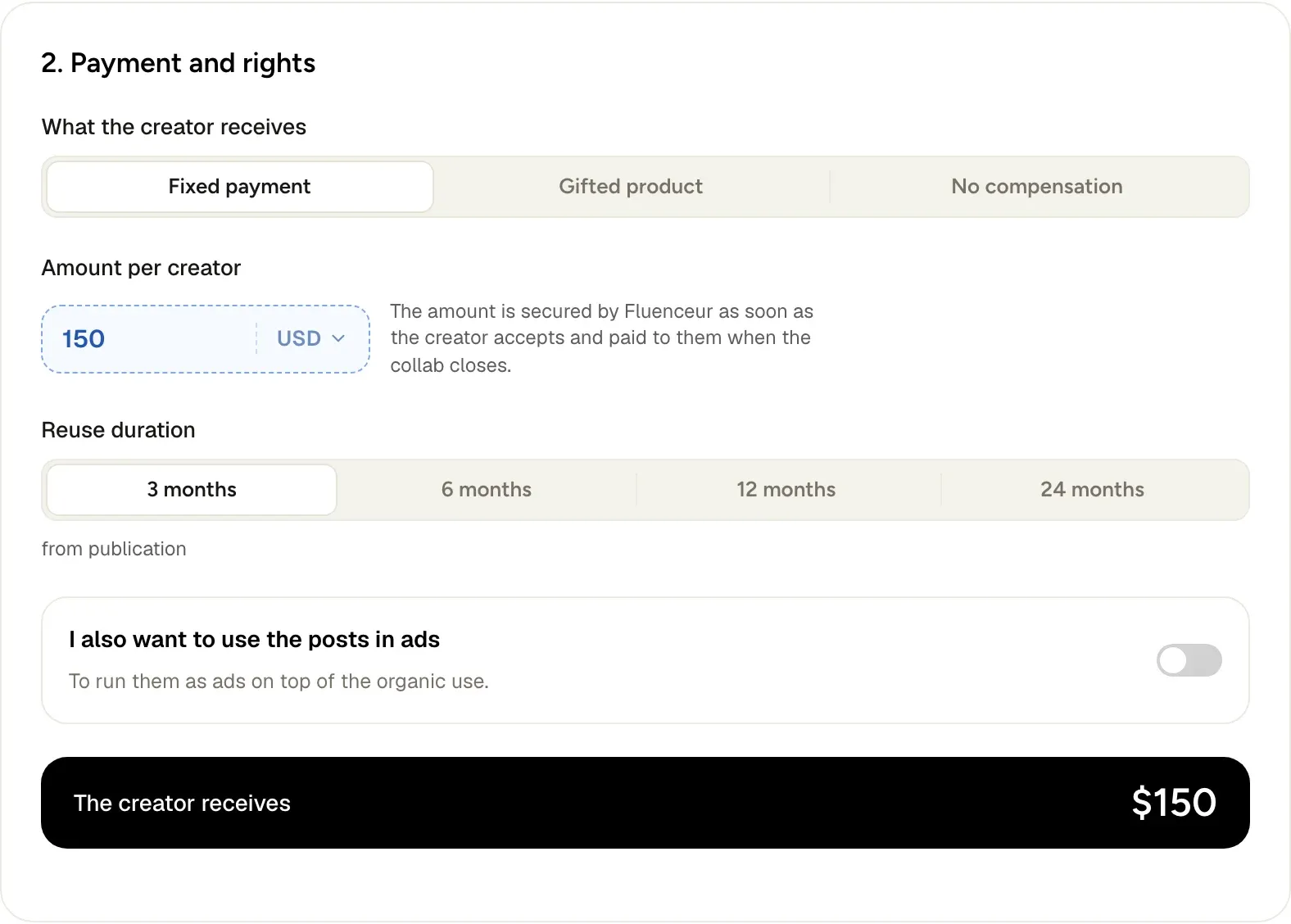
In Fluenceur, a collab brief offers the "Fixed payment" compensation, with this rule: "The amount is secured by Fluenceur as soon as the creator accepts and paid to them when the collab closes." The same block sets the "Reuse duration", and the "I also want to use the posts in ads" option adds ad usage. A sponsored post that performs then gets a second life as a partnership ad.
Why isn't commission alone enough to pay influencers?
Because it makes the creator work for free until something sells. They pay for the shoot and the edit up front, then depend on what they don't control: your product page, your price, your stock.
Creators say so themselves. In June 2024, a North American social media tools publisher asked 198 creators: 83% were highly willing to work on flat-fee campaigns, 54% on hybrid campaigns, and only 9% were very willing to join commission-only campaigns, which 41% said they would avoid altogether.
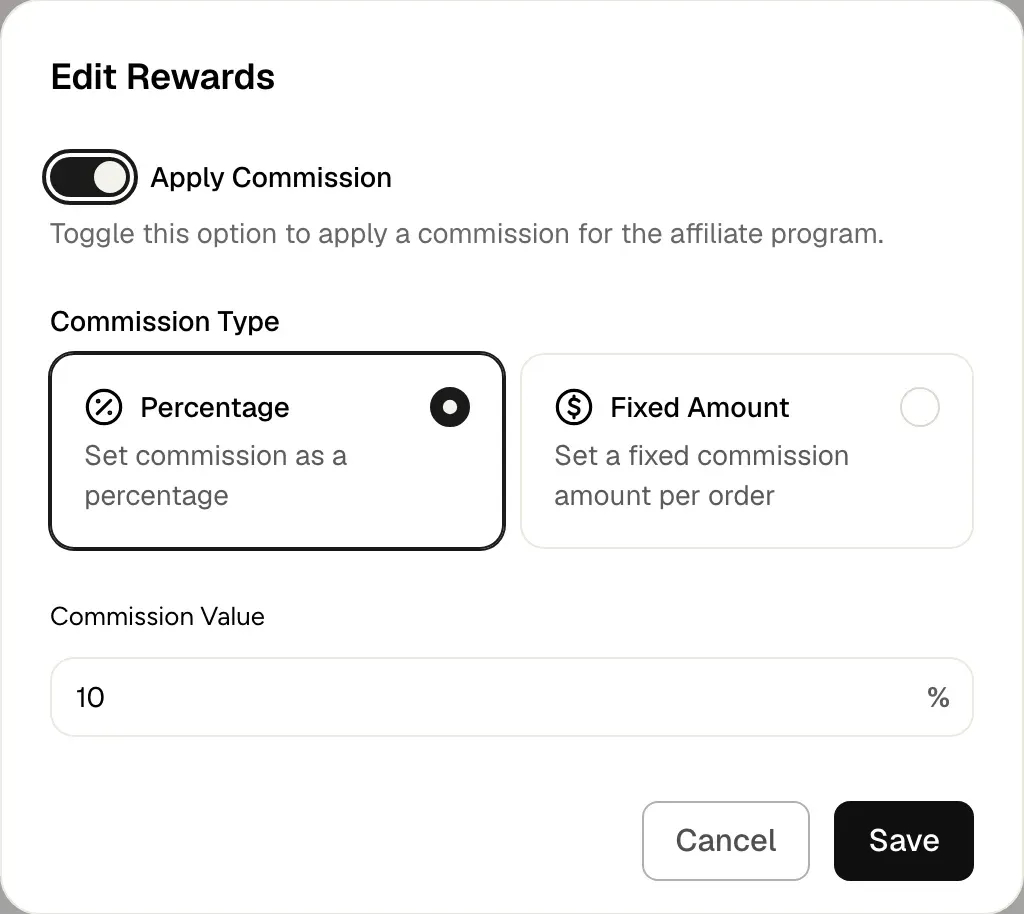
In Fluenceur, the "Edit Rewards" window of the affiliate program sets the commission as a "Percentage" or a "Fixed Amount" per order. The Shopify setup is covered in the affiliate program guide.
Why is a flat fee plus commission the best of both worlds?
Because it shares the risk instead of putting it all on one side. The flat fee guarantees the creator that the work is paid, so they say yes. The commission gives them a stake in the sales, so they stay engaged, with a reason to talk about the product again long after the post. Each also lowers the other: a smaller fee than in a flat-fee deal, a lower rate than in a commission-only one. It is the sturdiest model when sales are uncertain, which they almost always are early in a relationship. The trade-off: when everything sells, it costs more than the flat fee alone, but you are paying for sales already made. Fluenceur offers collaborations paid with a flat fee plus commission.
In what order should you combine a flat fee and commission?
From the lightest commitment to the heaviest: product to spot creators, a flat fee to get content, commission to make it last.
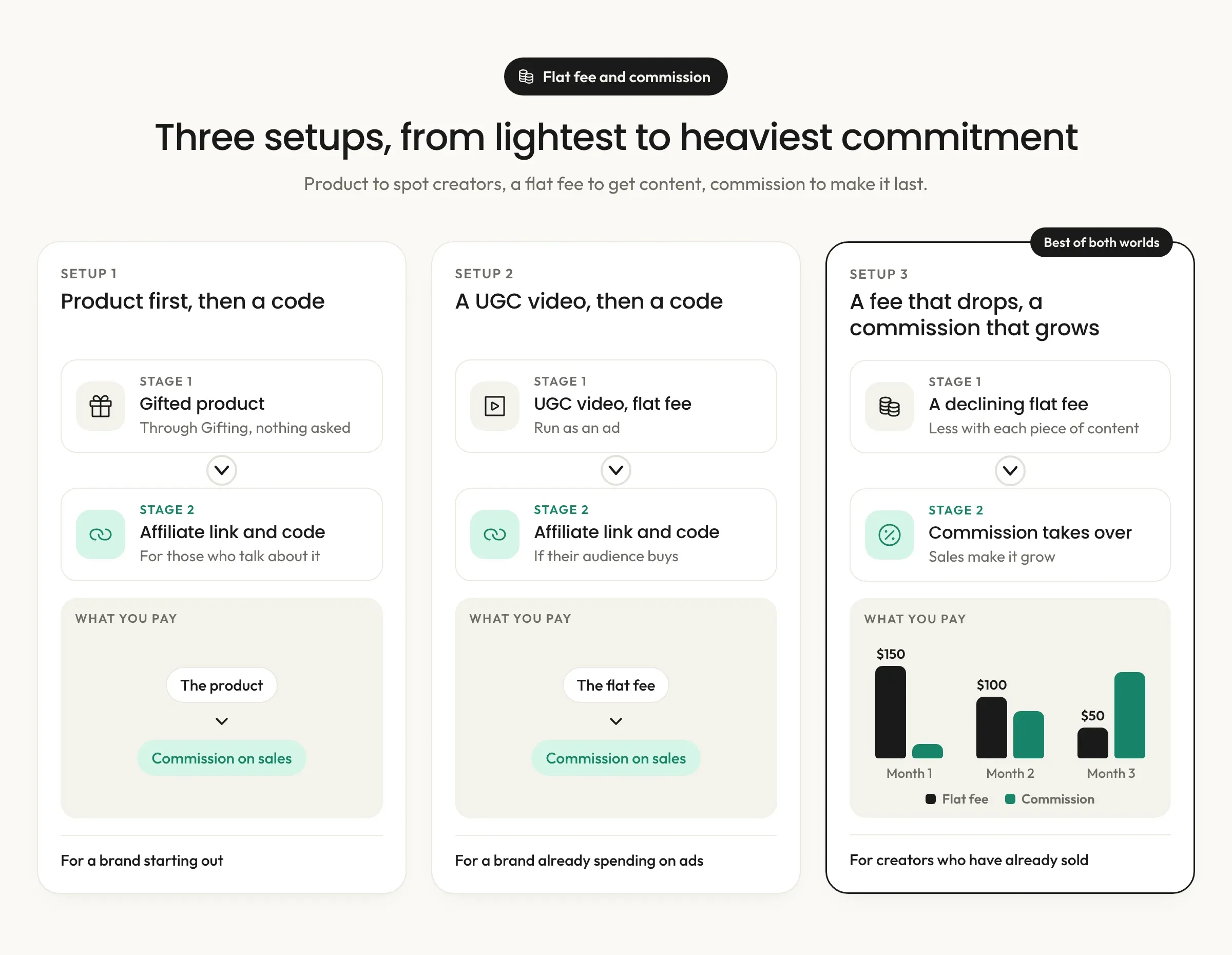
1. Product first, then an affiliate code for those who post on their own. You send the product through Gifting, with nothing asked in return. Social Listening spots the content that mentions or tags your brand; you open the affiliate program only to the creators behind it, with a link and a code in their name. Best for a brand starting out. Its limit: no content is guaranteed.
2. A UGC video paid with a flat fee and run as an ad, then an affiliate code. The fee pays for itself in your ads, not on the creator's account. In Fluenceur, the "UGC" collab is built for it: "The creator delivers files for your own channels. Usage rights included." If their audience buys, add a code. Best for a brand already running ads. Prepare it with finding UGC creators and writing the brief.
3. A flat fee that drops, a commission that takes over. The first piece of content is paid at full rate, the next ones less and less, while sales grow the commission. In Fluenceur, you raise an affiliate's rate with a custom commission when their flat fee ends. Best for creators who have already driven sales and turn down commission-only deals. The next step is the ambassador program.
Flat fee or commission: how do you choose based on your margin, order value and time to sale?
Three numbers decide: your margin sets the rate you can offer, your average order value sets what one sale earns the creator, and your time to sale sets how long they wait for a first payout.
A fictional example. Lathergrove, a shampoo and soap bar brand, collects $50 per order before sales tax and after the code discount, and keeps $30 of margin before paying the creator. It wants three videos in three months from the same creator and compares three offers.
| Line | Flat fee alone | Commission alone | Declining flat fee plus commission |
|---|---|---|---|
| Flat fee paid | 3 × $200 = $600 | $0 | $150 + $100 + $50 = $300 |
| Commission per order | $0 | 15% of $50 = $7.50 | 10% of $50 = $5 |
| Cost at 10 orders | $600 | $75 | $350 |
| Cost at 100 orders | $600 | $750 | $800 |
| Margin left at 10 orders | $300 − $600 = −$300 | $300 − $75 = $225 | $300 − $350 = −$50 |
| Creator's income with no sale at all | $600 | $0 | $300 |
At 10 orders, the flat fee alone loses you $300; commission alone pays $75 for three videos, an offer few creators accept. The hybrid cuts your loss to $50 and guarantees the creator $300. Below 60 orders, it also costs less than the flat fee alone. The ROI calculator reruns this with your numbers.
What mistakes should you avoid when you pay influencers?
Three come up again and again: a commission that is too low, usage rights left out, a payment made before approval.
A commission that is too low. A few cents per sale won't get anyone to post twice. If your margin can't support more, switch to the hybrid.
No usage rights negotiated. Without a duration and channels in writing, you can't run the video as an ad, and you'll renegotiate at the worst moment: after it performs. The Fluenceur brief spells it out: "Reuse without a duration or a channel grants nothing once accepted."
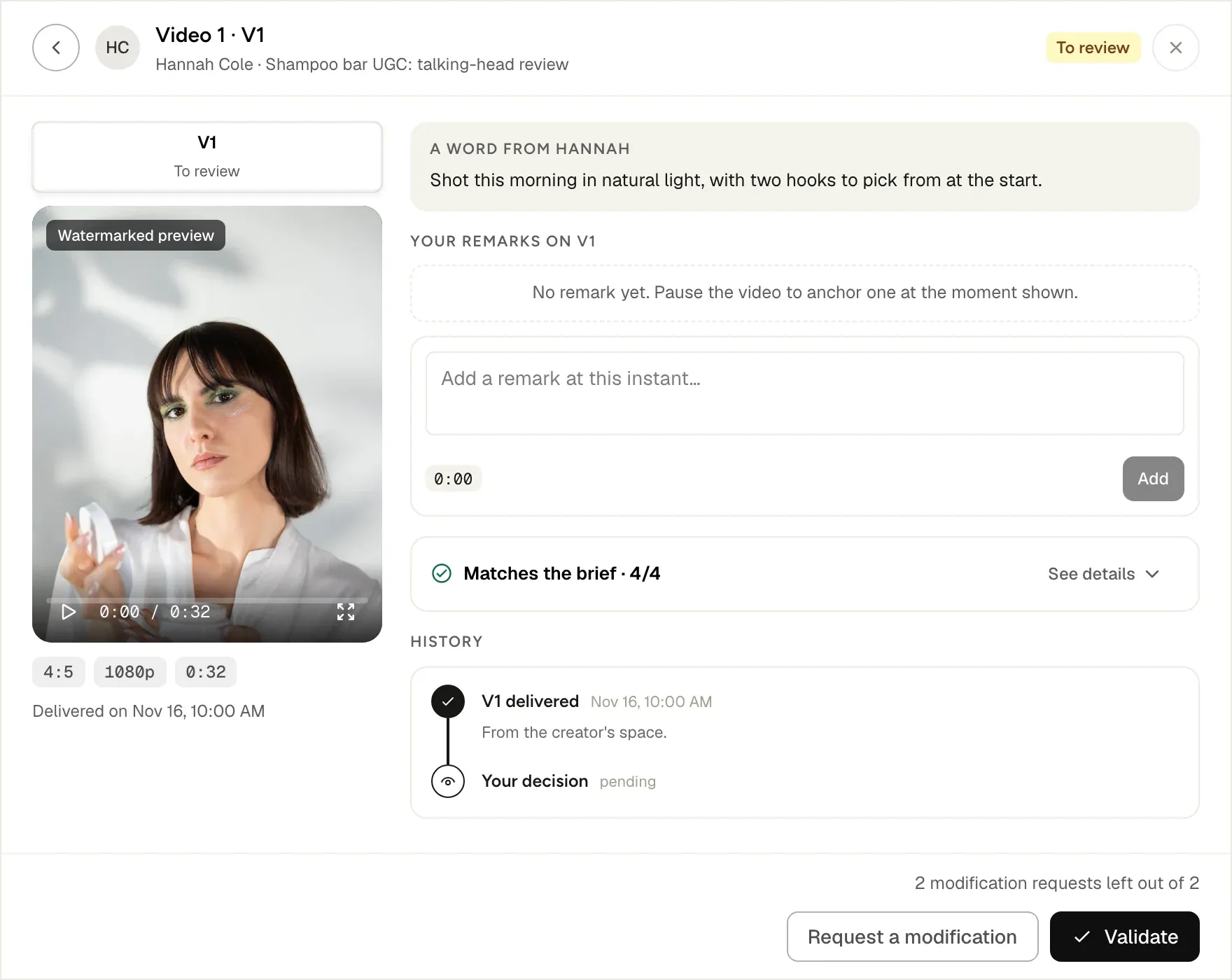
Paying before approval. A fee paid at signing leaves you no leverage to ask for a fix. In a Fluenceur UGC collab, you judge on a "Watermarked preview", you can "Request a modification", and "Each original unlocks at its validation, not at the payment."
Frequently asked questions
How much do influencers make?
What brands pay them: a flat fee per piece of content, commissions, products. The rates by account size and format are in How much should you pay an influencer?.
Should creators disclose a gifted product or an affiliate commission?
Yes, the FTC advises disclosing both: a free product, even when no review is required, and affiliate links, clearly and close to the recommendation, for example "I get commissions for purchases made through links in this post." The brand has a part too: "Advertisers need to have reasonable programs in place to train and monitor members of their network."
Key takeaways
- A flat fee pays for a piece of content, its rights and its date; commission pays for sales; a gifted product is how you spot the creators to offer either one.
- A flat fee plus commission is the model to aim for: it pays for the creator's work and ties the rest to your sales. Get there in order: product, then a flat fee for the content you reuse, then commission.
- Pick your starting point based on your margin, your average order value and your time to sale, and put usage rights in writing before you pay.
Was this helpful?