ChatGPT
 Claude
 Perplexity
 Google AI
In this article
- In short
- What is a UGC video, and how is it different from influencer marketing?
- How do you write a UGC brief template a creator can deliver?
- What does a filled UGC brief look like?
- What brief mistakes cost you a video?
- How much does a UGC video cost in 2026?
- Where do you find UGC creators and how do you choose them?
- Can Gifting replace a paid UGC video?
- What does US law say when you reuse a UGC video?
- Frequently asked questions
- Key takeaway
A UGC brief template fits on one page: the product and its promise, the audience, one angle, three hook ideas, the shots to film, what to say and what to avoid, the deliverables, the usage rights and the dates. The creator films alone: whatever the brief leaves out, they make up; whatever it dictates word for word sounds fake. Here is the template to copy, what a UGC video costs in the US in 2026 and where to find the creators.
What is a UGC video, and how is it different from influencer marketing?
A UGC (user generated content) video is a video with an amateur look, filmed by a creator for a brand, which runs it on its product pages, its social accounts and its ads. The creator is paid to produce, not to post; their follower count does not matter. Influencer marketing is the reverse: you pay for access to an audience, and the content stays on the creator's account.
| UGC video | Influencer collaboration | |
|---|---|---|
| What you buy | A production | An audience |
| Where the video runs | Your channels and your ads | The creator's account |
| What sets the price | Length, hooks, raw footage, rights | Real views, niche, rights, exclusivity |
| How to choose | Portfolio and on-camera presence | Engagement and an audience that buys |
| How to measure | Your ads and your pages | Link, code, attributed sales |
In paid social, the format costs less than a still image: across 15 split tests with e-commerce, retail and consumer goods advertisers, including small and mid-sized businesses, Meta measured a 34.5% lower cost per result for Reels campaigns using 9:16 video with sound, compared with the same campaigns run with an image (Meta's numbers, from Meta's own tests).
How do you write a UGC brief template a creator can deliver?
A good UGC brief template gives one message, one specific audience, hook ideas and a shot list, then lets the creator write their own lines. Three rules:
- One message per video: one benefit, one proof, one call to action.
- Hooks, not a script: the creator picks an opener and rewords it.
- Show, don't tell: "texture on the back of the hand" beats "show that it melts in".
The template to copy. Keep it as casual as the creator you are writing to:
UGC BRIEF · [Brand] × [Creator first name]

1. PRODUCT AND PROMISE
Product: [name, price, product page link]
Promise: [what the product changes, in one sentence]
Proof: [test, ingredient, verified review]

2. AUDIENCE
[Age, situation, problem to solve, objection #1]

3. ANGLE AND HOOKS (first 3 seconds)
Angle: [problem then result / unboxing / routine / review after a few weeks]
Hook 1: [line or gesture]
Hook 2: [line or gesture]
Hook 3: [line or gesture]
The creator picks one and rewords it in their own voice.

4. FORMAT
Vertical 9:16, [15 to 45] seconds, talking to camera, natural sound, daylight, captions [yes / no].

5. SHOT LIST
Hook to camera · product in hand, label readable · close-up of it in use · result · call to action.

6. SAY, DON'T SAY
Say: [product name, main benefit, call to action]
Don't say: [unproven claims, competitors, "the best"]

7. DELIVERABLES
[1] edited video + [3] hook variations + raw footage [yes / no]. MP4 1080 × 1920 minimum, no licensed music.

8. USAGE RIGHTS
Channels: [website, social accounts, Meta and TikTok ads] · Term: [3 / 6 / 12 months] from approval · Exclusivity: [none / category, term]

9. TIMELINE AND PAYMENT
Product ships [date] · First cut: [x days after delivery] · Final: [y days] · [2] change requests included
Payment: [amount, itemized, due date]

10. LEGAL
Usage rights granted in writing. Posted on the creator's account: "Ad" or "Sponsored" in the video itself, not only in the caption. Run by the brand: never presented as an independent customer review.
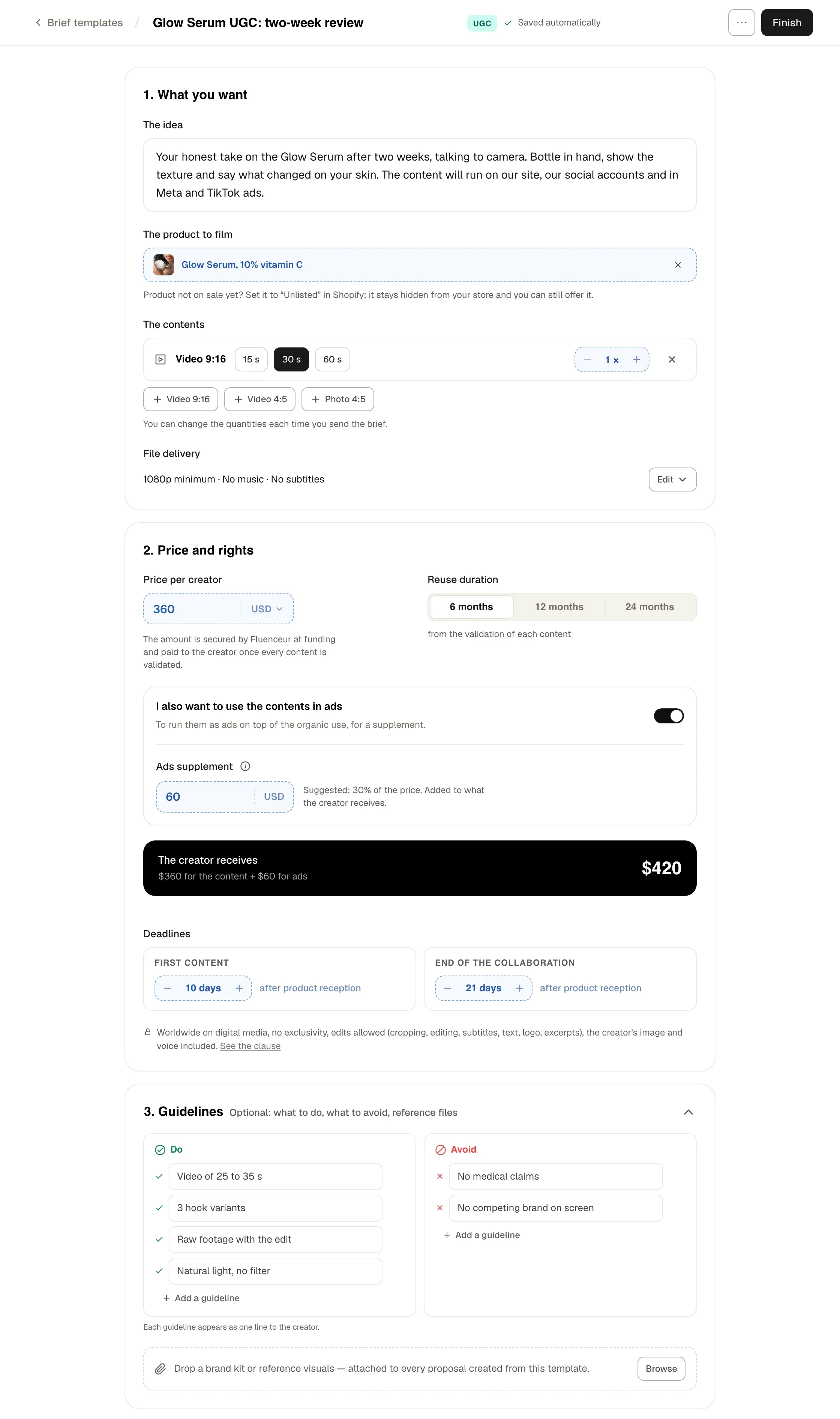
On Fluenceur, this brief becomes a template in your Brief templates library, proposed to each creator. The product ships from your Shopify catalog, the deadlines start when the creator receives it, and the amount, secured at funding, is paid once every piece of content is validated. The steps are in the UGC section of Fluenceur for Shopify.
What does a filled UGC brief look like?
A page where every line has a number. An excerpt from the brief of Early Light Skincare, a skincare brand invented for this example, which launches a $42 vitamin C serum; the brief talks to the creator the way you would in a DM:
Hook 1: "I quit every vitamin C that stings, except this one."
Hook 2: half-used bottle in hand: "Two weeks in, here's my honest take."
Hook 3: "If your vitamin C turned orange, watch this."
You pick one and say it your way.
Deliverables: 1 edited video + 3 hook variations + raw footage, MP4 1080 × 1920.
Rights: Early Light website, social accounts, Meta and TikTok ads, 6 months from approval.
Payment when the final is approved, $420: video $150, paid ad rights 6 months $60, 3 hooks $150, raw footage $60.
The rest of the brief (product, audience, shots, dos and don'ts, timeline) is in the editor below.
What brief mistakes cost you a video?
Five mistakes end in "we can't run this":
- Too many messages: five benefits in 30 seconds sound like a product page read aloud.
- A dictated script: the creator recites, viewers spot an ad and scroll.
- No hook: "Hi everyone, today I want to show you" loses the audience before the product.
- Forgotten rights: without paid ad rights in writing, no Meta Ads; asked for afterward, they cost more.
- The package before the brief: the brief goes out first, and the deadlines start when the product arrives.
How much does a UGC video cost in 2026?
In the US, a UGC video costs $150 to $300 in 2026 according to the rate guides published by UGC agencies and platforms: around $100 for a beginner, $500 to $1,200 for a creator whose videos have already run as ads. These are vendor numbers: there is no independent price index for UGC.
What comes on top, according to the same grids:
| Option | Add-on in the published grids |
|---|---|
| Concept and script written by the creator | $150 to $250 per concept |
| Hook variations | $50 each, $150 for a pack of three |
| Raw footage | +30 to 50% of the base rate, often +40% |
| Paid ad rights (Meta Ads, TikTok Ads) | +20 to 50% for 3 to 6 months, +70 to 100% for 12 months |
| Exclusivity (category, 3 to 6 months) | +30 to 50% |
An example: a $200 video with paid ad rights for 6 months (+40%, so $80), three hook variations ($150) and the raw footage (+40%, $80) comes to $510, before product and shipping. Fix these lines in the brief, not after delivery. The price of a UGC video does not depend on follower count, unlike an influencer's fee: see How much should you pay an influencer?.
Where do you find UGC creators and how do you choose them?
The best UGC creators are often already your customers: the people who post your product without being asked have the tone and the credibility the brief is looking for. Four sources:
- Your customers who already post, surfaced by Fluenceur's Social Listening (How to find influencers already talking about your brand). Offer them a paid video, with the rights.
- Your Gifting creators, the ones who filmed the product they received.
- UGC portfolios: ask for three past videos in your category.
- Creator Discovery: the "Offers UGC" filter keeps the creators who turned on UGC. Their card shows the UGC badge and their starting rate per video; "Propose a UGC" sends them your brief.
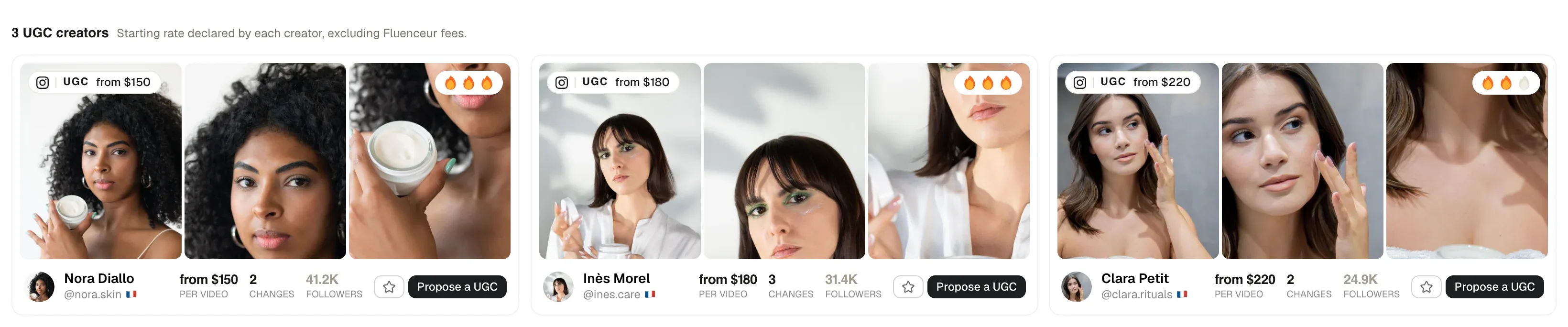
To decide: believable on camera within ten seconds, a hook that holds with the sound off, a readable product, a written rate card. If the creator also posts with a link or a code, see Measuring creator sales: link, code or tag?.
Can Gifting replace a paid UGC video?
It depends: yes when the creator has already filmed your product on their own, no when you need a specific format. A Reel posted after a Gifting shipment can be reused with the creator's written permission, on your social accounts, your product pages or in your ads. Fluenceur's Social Listening surfaces those posts, and on Instagram, "Boost this media" asks the creator for permission to run one as a partnership ad. But with no fee, you impose no shots, no hook, no deadline: the moment you need a brief, it is a paid UGC video. The shipping method is in How to automate influencer gifting on Shopify.
What does US law say when you reuse a UGC video?
Reusing a paid UGC video is legal in the US as long as three things hold:
- A written license: the creator who films the video owns the copyright, the US Copyright Office explains, so you get the rights your signed agreement grants and nothing more.
- Never a fake customer review: since October 21, 2024, the FTC's Consumer Reviews and Testimonials Rule (16 CFR Part 465) bars a business from running a testimonial it knew or should have known misrepresents the person's experience. "Maya, customer for two years" on a paid creator's video is the case it targets.
- Disclosure when the creator posts: the FTC's Endorsement Guides call for a clear disclosure of any payment or free product, such as "ad" or "sponsored" in the video itself.
Frequently asked questions
How long should a UGC video be?
15 to 45 seconds for an ad, vertical 9:16. TikTok for Business says 21 to 34 seconds perform best for In-Feed ads, with the hook in the first three seconds.
How many hooks should you ask for?
Three variations on the same video body, enough to test which one stops the scroll in your ads. Beyond that, order a second video with another angle.
Key takeaway
A UGC brief fits on one page: one message, one audience, three hooks, a shot list, the deliverables, the rights and the dates. A video costs $150 to $300 in the US in 2026, with paid ad rights and hooks on top, to be fixed in the brief. Look first among your customers and your Gifting creators, and get the usage rights in writing.
Was this helpful?