In this article
- In short
- Why start with the influencers who already know your brand?
- Step 1: where to find influencers already talking about your brand
- What works by hand, and where it breaks
- Step 2: how to read a mention and qualify an influencer
- How to read a mention
- How to qualify an influencer
- How to spot a fake influencer
- Step 3: how to find influencers who look like the ones you have
- Step 4: how to contact an influencer
- Step 5: how to turn a mention into measured sales
- The checklist
- Frequently asked questions
- Key takeaway
The fastest way to find influencers for your brand is to start with the ones already talking about it: the Tagged tab on your Instagram profile, your story and comment mentions, and your customer list. Work through those before you go looking for strangers by hashtag. A customer who posts your serum in a story without being asked is already half recruited: she bought it, she liked it, and she told her followers. The method takes five steps: spot, qualify, widen, reach out, then measure the sales.
Why start with the influencers who already know your brand?
A creator who already talks about your brand converts better than a stranger because their recommendation sounds like one from a friend: in Nielsen's Trust in Advertising study (September 2021, more than 40,000 consumers), 88% of respondents said they trust recommendations from people they know more than any other channel. And that trust turns into sales: according to a consumer survey from the second quarter of 2026, relayed by Shopify in September 2026, 67% of consumers have bought something because an influencer recommended it, rising to 81% among Gen Z.
The customer who posts your serum to her 3,000 followers has already said yes to the product, her post reads like a review rather than an ad, and she cost nothing to find. You just have to notice her.
Step 1: where to find influencers already talking about your brand
Seven free sources show you who already posts about you: the Tagged tab, story mentions, untagged mentions, your customers, your followers, comments and DMs, and the accounts tagging your competitors. Log every account in a spreadsheet: handle, source, date, followers.
| Source | What you find | The catch | How to catch it |
|---|---|---|---|
| The Tagged tab on your Instagram profile | Posts and Reels where an account tagged you | No stories, no captions without an @ | Check it once a week |
| Story mentions | A customer who @-mentions you in a story | Per Instagram, the preview drops out of your DMs after 24 hours | Reply and log the account the same day |
| Untagged mentions | Your brand name written in a caption or said out loud in a video, no @ | No notification | Search your name, misspellings included: TikTok indexes captions, Instagram far less |
| Your customers | Buyers already posting in your category, sometimes with your product in frame and no name | You have their email, not their handle | Ask for the handle in the post-purchase email, watch for reviews with photos |
| Your followers | Public accounts posting about your world | You have to open them one by one | Scroll the list, keep anyone past 1,000 followers |
| Comments and DMs | People who ask questions and come back under every post | The volume | Spot the accounts that comment more than once |
| Competitors and your category | Creators who tag a comparable brand or your niche hashtags | Brand fit still has to be checked | Open the Tagged tab of three competitors, note the accounts that show up more than once |
After an hour you have twenty to fifty accounts, and every name has a reason to be there.
What works by hand, and where it breaks
A brand that gets a dozen mentions a month can do this by hand: keyword and hashtag search, the Tagged tab, mention notifications and, on TikTok, the "Mentions and tags" filter in the inbox. For what the platforms don't flag, two workarounds: search your brand name on TikTok, which indexes captions (Instagram search does this far less), and eyeball your customers' and followers' posts for your product shown without its name. Content that never names the brand triggers no alert, so that part stays manual.
Two things break as volume grows.
- Stories. According to Instagram, a story disappears after 24 hours. One unwatched Sunday and the mention is gone.
- Volume. Past a hundred mentions a month, monitoring eats half a day a week, and nobody has time left to qualify anyone.

That's the job of Fluenceur's Social Listening: it surfaces the content that mentions your brand on Instagram and TikTok, posted without you asking, stories included, along with the creator's data (number of mentions, engagement, fit with your Brand DNA, whether you have already been in touch). Every row in the spreadsheet arrives already qualified.
Step 2: how to read a mention and qualify an influencer
How to read a mention
A mention is a piece of content (post, Reel, story or comment) that names your brand, with or without an @, and four signals tell you what it's worth: repetition, format, performance, and whether it carries a link or code.
- Repetition. Three mentions in ten days are worth more than one from an account twice the size.
- Format. A story is an everyday gesture. A Reel about your product is an editorial choice: the person gave you their most visible slot.
- Performance. A mention that beats the account's median proves its audience wants your product.
- No link, no code. The mention is unprompted: the most credible kind for their followers, and the easiest to turn into a collab.
How to qualify an influencer
Five criteria qualify an influencer in three minutes a profile: real audience, engagement, brand fit, recent activity, and where the followers live.
- Real audience.An account with 20,000 followers whose Reels top out at 300 views does not have 20,000 people behind it.
- Engagement.Likes and comments divided by followers. According to figures published by Shopify in September 2026, the smallest accounts, under 5,000 followers, have the highest engagement rates, about 2.6%, and rates drop below 1% for mega-influencers. A micro creator at 5 or 6% is holding their community.
- Brand fit.Does their content from the last three months look like what you sell? Ten competing brands in one month is a no.
- Recent activity.An account with nothing posted in three months will bring you nothing next month, whatever its size.
- Where the followers live.A US creator can have 60% of her followers outside the US: if you don't ship there, most of her reach is wasted.
Criterion 5 cannot be read from a public profile. Fluenceur shows the official Meta and TikTok API data for every creator: engagement, audience split by gender, age and country, past collaborations. And the database only holds active creators: an account with no post in more than 90 days does not appear in it.
How to spot a fake influencer
Two minutes and five checks expose a fake influencer.
- Views against followers.50,000 followers and 500 views per Reel: bought audience, or a lost one.
- Follower jumps.A 10,000 leap in a week with no viral Reel behind it.
- Account age.Three months old with 80,000 followers.
- Comments.Emoji with no text, accounts with no photo, identical messages under every post.
- Content.Visuals lifted from other creators, and a person who never appears on screen.
Step 3: how to find influencers who look like the ones you have
Use the profile of your first twenty accounts (niche, size, tone, audience) to find the next ones. By hand, two shortcuts: the accounts Instagram sometimes suggests after you follow someone, and the Tagged tab of your best creators. That gives you leads, not a list, and you can't filter any of it. There's no way to ask "skincare creators, 10,000 to 50,000 followers, audience in the US, active this month."
That's exactly the request Creator Discovery understands. You describe the creators you want in plain language, refine as the conversation goes, and filter by niche, location, audience size, engagement rate, audience profile and recent activity, on Instagram and TikTok. Results are ranked by closeness to your Brand DNA before audience size: an account with 30,000 followers that talks the way you do comes ahead of one with 300,000 that talks about everything. See Creator Discovery.
Step 4: how to contact an influencer
Three lines of DM are enough for a first contact: the exact content you saw, a concrete offer, a question to close. No brief, no contract, no "we are a purpose-driven brand." Both messages below keep it casual: first name, warm, short. What kills a DM is length and vagueness.
Hi Maya, we saw your story with the Night Serum, thank you! We're putting together a collab with a few customers who already love the brand: the new moisturizer before it launches, on us, plus a code in your name if you feel like telling your followers about it. Interested? Jess, Marlowe SkincareHey Jordan, your Reel on the three-product morning routine is spot on. We're Marlowe, a small-batch skincare brand out of Austin. No script, no strings: we send you the full routine, you try it, and you only talk about it if you like it. Want me to send the box? JessStep 5: how to turn a mention into measured sales
Three moves turn a mention into a sales channel, from the very first collab: a gifted product, a link and a code in the creator's name, a commission when it sells. Most brands stop at spotting and reaching out. Very few turn those creators into sales.
- A product, not a brief. Gifting answers an unprompted mention: you offer what they already like. Shipping and tracking, step by step: How to automate creator Gifting on Shopify.
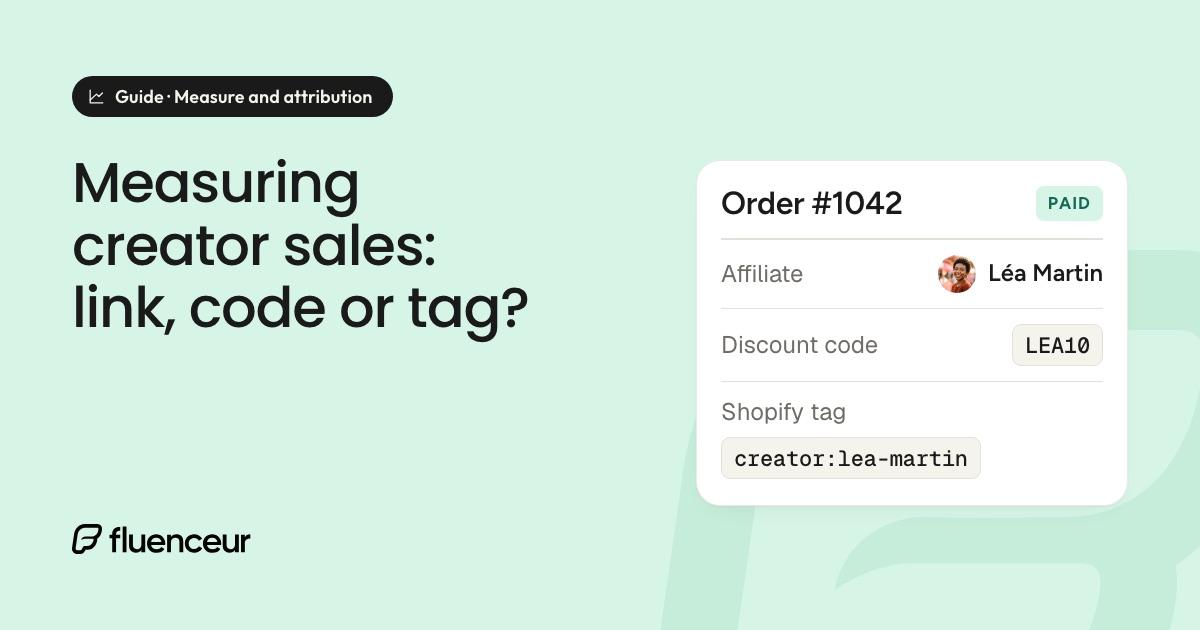
- A link and a code in their name. Without them you'll never know whether their followers buy: Measuring creator sales: link, code or tag?.
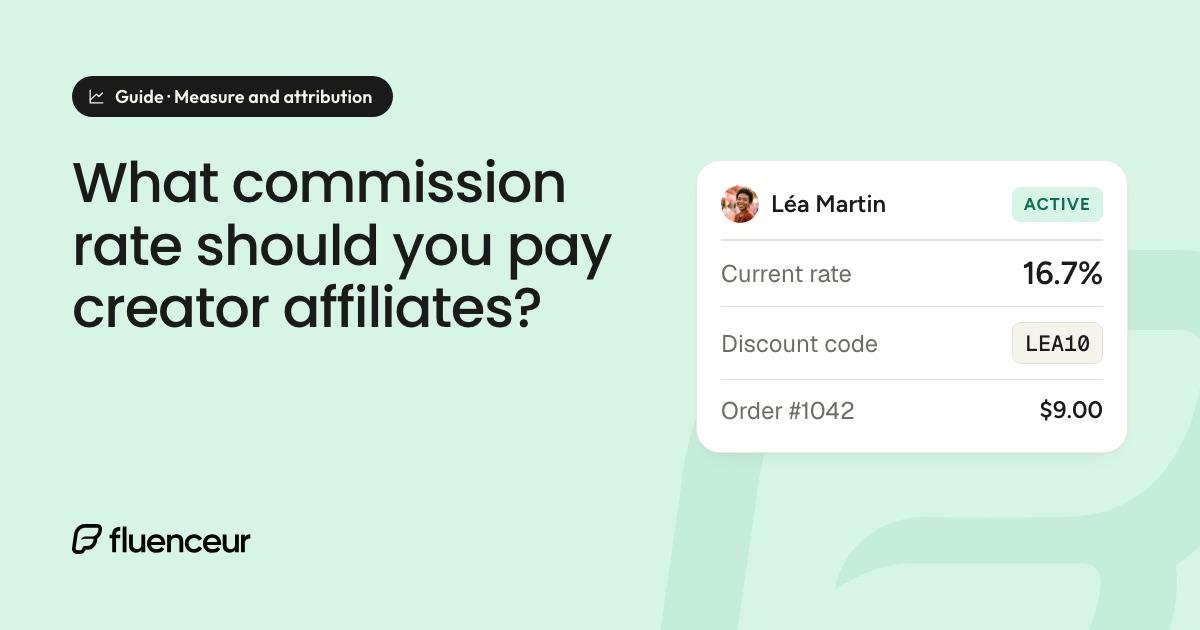
- A commission when it sells. The customer becomes an affiliate without changing her tone: What commission rate for your affiliate creators?.
A hypothetical example. Maya, 4,200 followers, receives the moisturizer on the 3rd of the month with a link and the code MAYA10. Two stories and one Reel later, on day 30: 25 attributed orders, $1,100 in revenue before tax, $110 in commission at 10%, for a package that cost $12 to send. The call is easy: run it again next month, with the rate going up to 12% past 40 orders.
Fluenceur is an influencer and affiliate marketing platform for e-commerce brands: it brings together creator search, collaboration management (Gifting, sponsored content, affiliation, co-advertising) and sales attribution, connected to Shopify. Social Listening surfaces the mention, Gifting creates the order in your store and triggers the shipment, then a link and a code per creator attribute every sale and calculate the commission.
The checklist
- The Tagged tab is reviewed every week, and every new account is logged.
- The brand name has been searched on Instagram and TikTok, misspellings included.
- The post-purchase email asks for the Instagram handle.
- Every account in the pool passes the five criteria and the five fake-account checks.
- The DM names the content you saw and offers a product, not a partnership.
- The creator's link and code exist before the package ships.
- A reminder is set 30 days out to read the attributed sales.
Frequently asked questions
How many followers is a micro-influencer, and is there a minimum?
A micro-influencer is a creator with 10,000 to 99,999 followers, according to the breakdown published by Shopify in September 2024; a nano-influencer has 1,000 to 9,999, a macro-influencer 100,000 to one million, a mega-influencer more than a million.
- Nano: 1,000 to 9,999
- Micro: 10,000 to 99,999
- Macro: 100,000 to 1 million
- Mega: More than 1 million
There is no minimum: a customer with 2,000 followers who posts your product unprompted is worth a test, and within two weeks you will know whether her followers buy.
How do you know if an influencer has fake followers?
Start by comparing views to followers: Reels at 500 views on a 50,000-follower account point to a bought or lost audience. The five checks in step 2 (views, follower jumps, account age, comments, content) take two minutes, and attributed sales settle it after a month.
How do I find influencers on Instagram when nobody is talking about my brand yet?
Start from the category: open the Tagged tab of three comparable brands and note the accounts that keep showing up. Search your niche hashtags, #skincareroutine rather than #beauty. And ask for the Instagram handle in your post-purchase email.
How do I find influencers talking about my brand on TikTok?
On TikTok, the app notifies you when an account tags you with an @, and the inbox can be filtered on "Mentions and tags." Without an @, there is no notification: search your brand name in the search bar, which indexes captions, misspellings included.
How do I find micro-influencers near me or in my niche?
Local micro-influencers turn up through city hashtags, tagged locations (your store, a salon, a farmers market) and the accounts that tag neighboring businesses. Niche micro-influencers show up among the accounts that tag your competitors. In both cases, check the city and country of the followers, not only the creator's.
How do I choose the right influencer for my brand?
Pick the influencer whose followers look most like your customers, not the biggest one. Between two accounts already talking about you, take both: a package costs little, and after a month the sales attributed to each one settle it.
Should I DM or email an influencer?
DM a micro creator; use the email in their bio once they pass 100,000 followers or list an agency. Three lines are enough: the content you saw, what you're offering, a question. A free product gets a quick yes; a partnership to negotiate gets left on read.
Key takeaway
The best influencers for your brand have already posted about it. List them from your tagged posts, your mentions, your comments and your customers, qualify them, then widen the search to creators who look like them. Keep the DM short. And give them a link and a code with the first package: that is what turns a mention into a sales channel.
Was this helpful?