ChatGPT
 Claude
 Perplexity
 Google AI
In this article
- In short
- What are Instagram partnership ads, and why do they beat a brand ad?
- The 6-step loop: how do partnership ads feed your affiliate program?
- Which posts should you boost as partnership ads? Attributed sales first
- How do you set up your first partnership ad? Budget, duration, audience, destination
- A worked example: $300 over seven days
- Should you pay the creator for usage rights?
- What does the FTC require on a partnership ad?
- What mistakes ruin a partnership ad?
- Frequently asked questions
- Key takeaways
To boost an influencer's post with Instagram partnership ads, you get the creator's authorization through Meta, then run their post as an ad from their account, on your budget, to people who don't follow them yet. Pick the post that has already sold, not the one with the most views: you are funding proof, not a creative bet. In Fluenceur, it starts from the mention and the "Boost this media" button.
What are Instagram partnership ads, and why do they beat a brand ad?
An Instagram partnership ad is a Meta ad built from a creator's post, with their authorization and their handle in the ad header next to your brand's; the industry also says whitelisting, or allowlisting. It beats a brand ad because it reads like a recommendation, not a banner, and per Instagram these ads "leverage signals from both accounts."
According to a Meta white paper published October 7, 2026 and reported by the trade press, 20 studies run by EMEA advertisers show a median cost per incremental purchase 45% lower and a median incremental ROAS 35% higher when at least 30% of a campaign's assets are partnership ads. Those are medians across mixed campaigns: they do not guarantee that one post will beat your best ad.
| Brand ad | Partnership ad | |
|---|---|---|
| Account the ad runs from | Yours | The creator's, your brand co-signed in the header |
| Creative | To produce, to test | Already posted, sales already measured |
| Authorization | None | The creator's, revocable |
| Audience signals | Yours | Yours and the creator's |
This guide covers Instagram, the only network where Fluenceur runs partnership ads.
The 6-step loop: how do partnership ads feed your affiliate program?
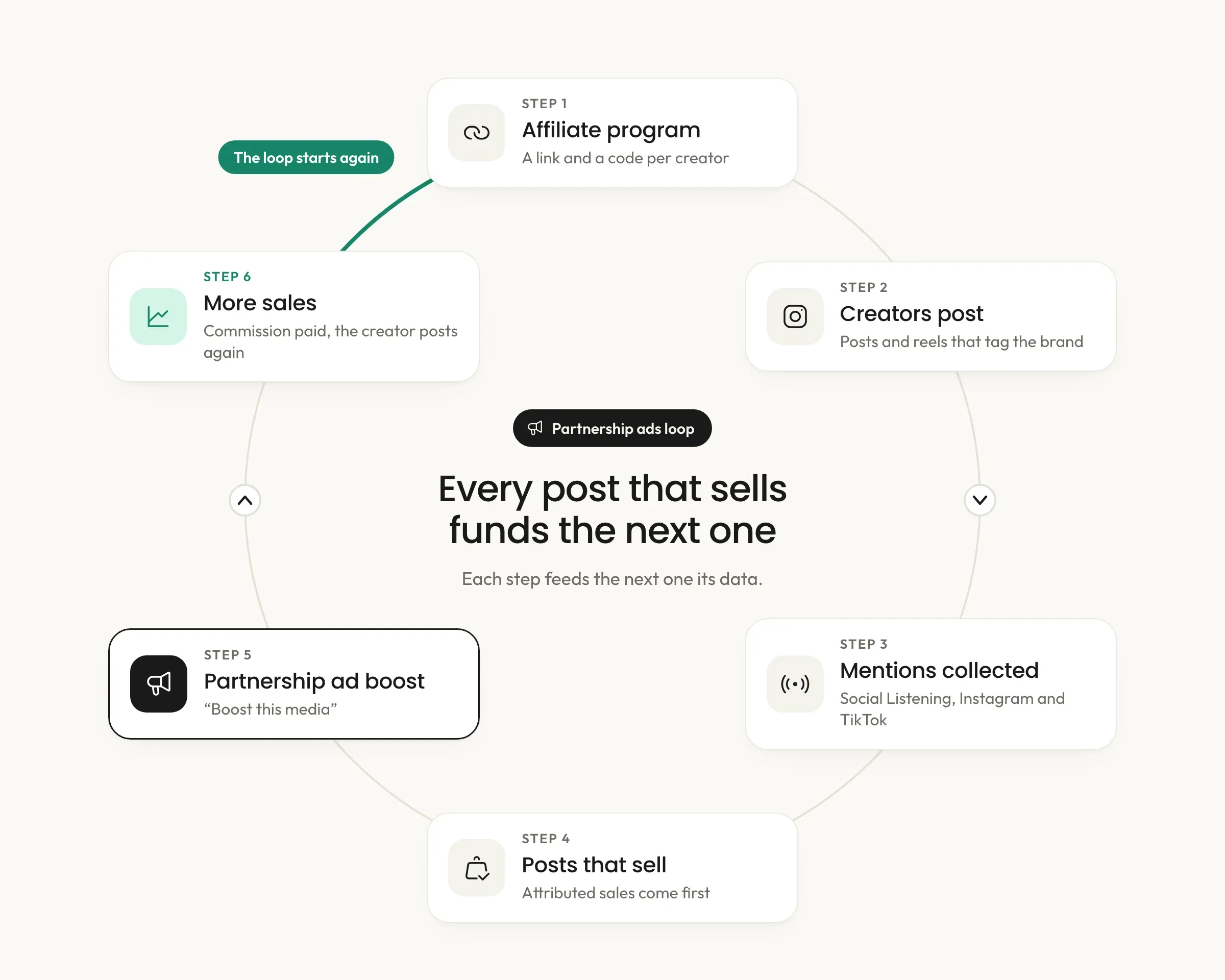
Partnership ads rest on your affiliate program and relaunch it: affiliates produce the posts, their sales pick which ones to boost, and the boost brings new sales back.
1. You launch an affiliate program. Every creator gets a link and a code in their name; Fluenceur attributes every sale, deducts refunds and pays the commission automatically. To set the rate: creator commission rates by industry.
2. Creators post. With their link, their code and your brand tag (the paid partnership label or an @mention): that tag is what makes the post usable as a partnership ad. Ask for "#ad" at the start of the caption too.
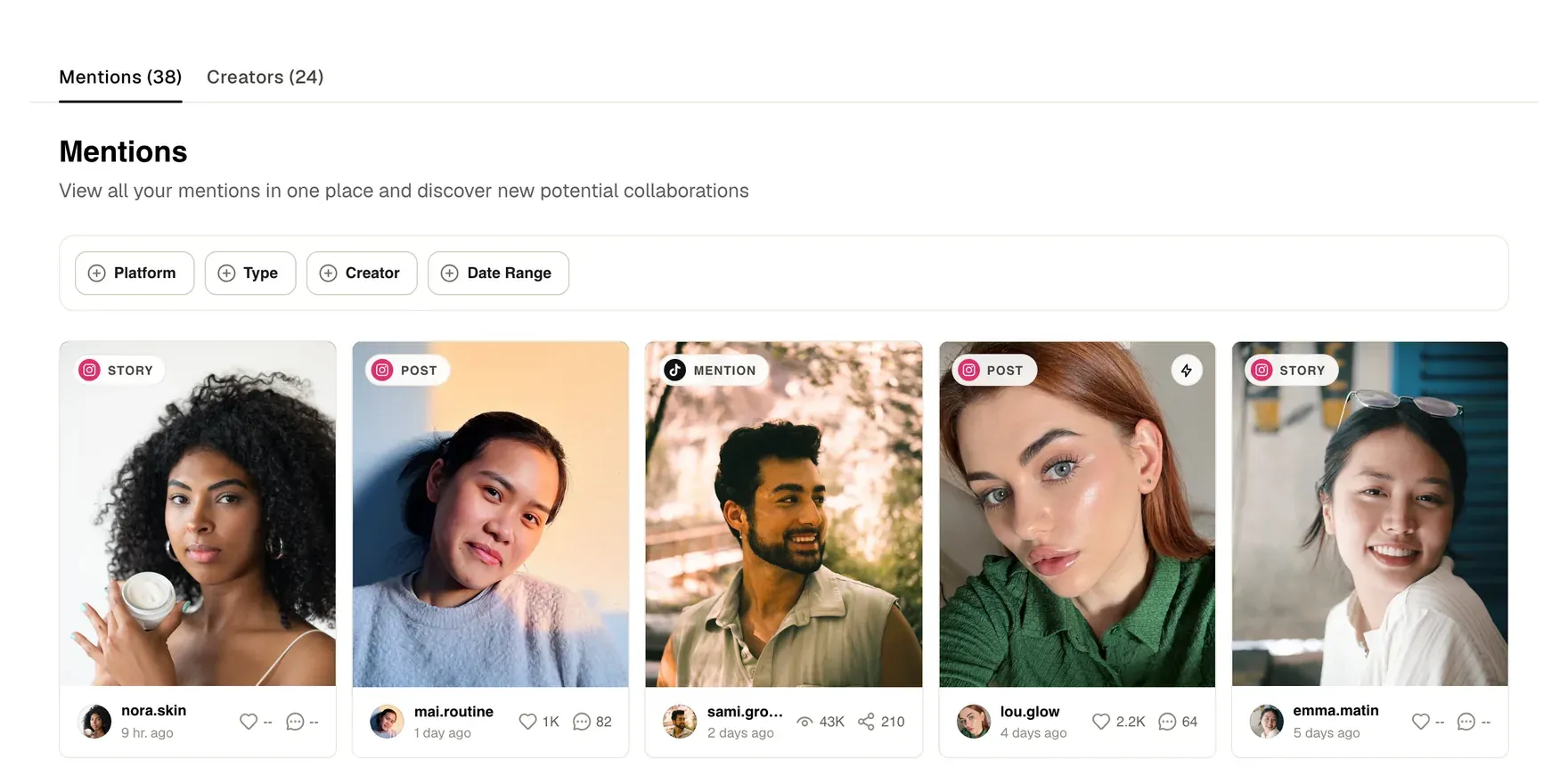
3. Fluenceur collects their mentions. Social Listening surfaces the Instagram and TikTok content that names or tags your brand, with each post's engagement and "Organic performance" curve. It also reveals the creators already talking about your brand.
4. You spot the posts that sell. Sales attributed to the link and code outrank engagement, as detailed below.
5. You boost those posts. "Boost this media" requests the creator's authorization, offers display rights and sets up the campaign.
6. The ads bring back sales. Every sale from the boost earns the creator their commission, which gives them every reason to post again: back to step 2.

Fluenceur is an influencer and affiliate marketing platform for e-commerce brands: creator search, collaborations (Gifting, sponsored content, affiliation, partnership ads) and sales attribution, connected to Shopify.
Which posts should you boost as partnership ads? Attributed sales first
Boost the post that has already sold to the creator's followers: what converts an audience that knows them stands a good chance of converting an audience that looks like them. Rank your mentions in this order.
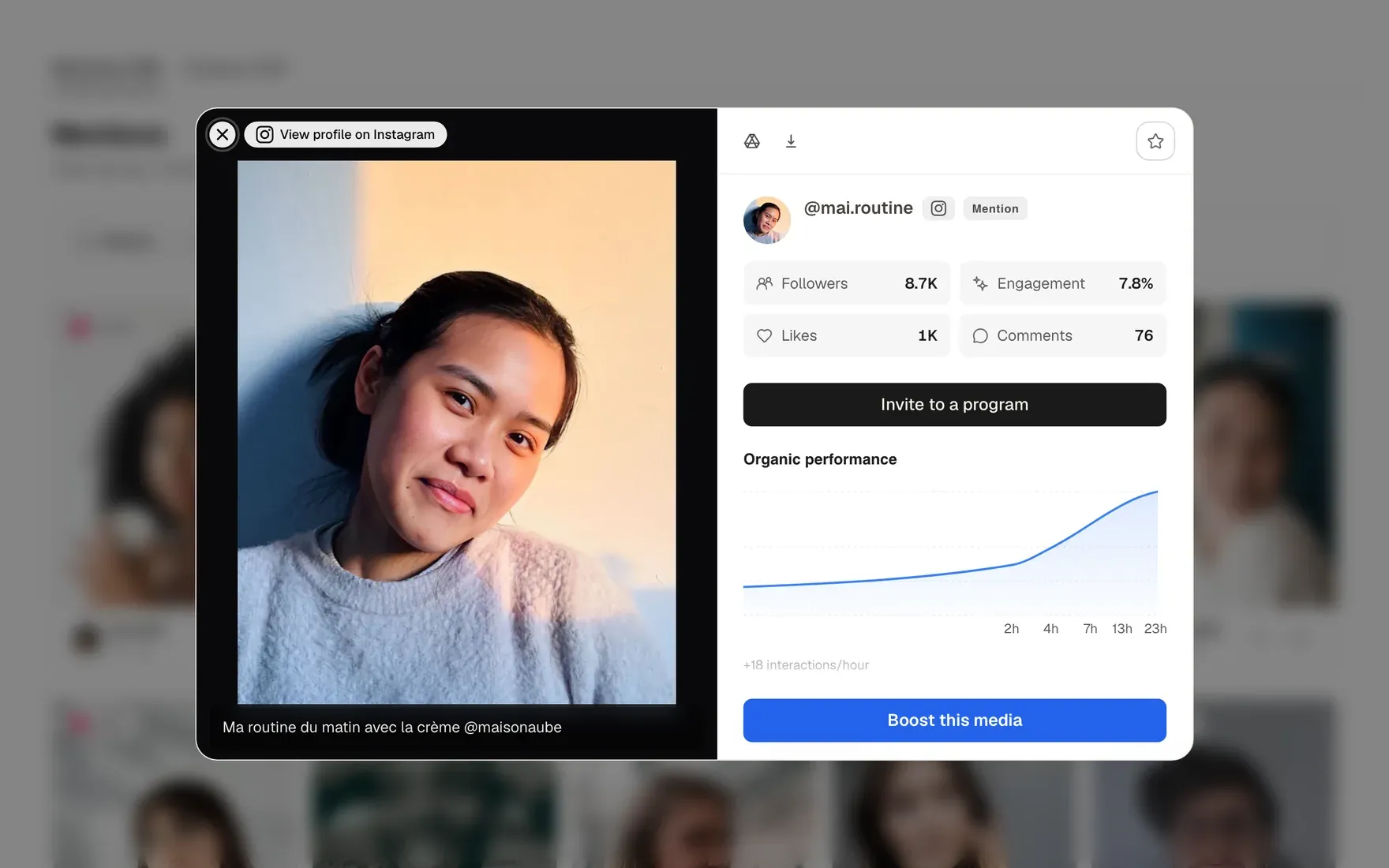
- Attributed sales. A post with 8,000 views and twelve orders goes ahead of a post with 120,000 views and two orders. Not measuring those sales yet? Start by measuring your creators' sales.
- What kind of engagement. "Where do I get it?" and "just ordered" are buying signals; a flood of hearts is not.
- The "Organic performance" curve. Flat after a few days, it shows the followers have all seen it: the boost brings a new audience.
- The format. A Reel or a feed post, carousels included, with no licensed music, which Instagram excludes. No Stories: Fluenceur does not boost them.
- The rights. The creator agrees to the ad, and you are ready to pay for that use.
How do you set up your first partnership ad? Budget, duration, audience, destination
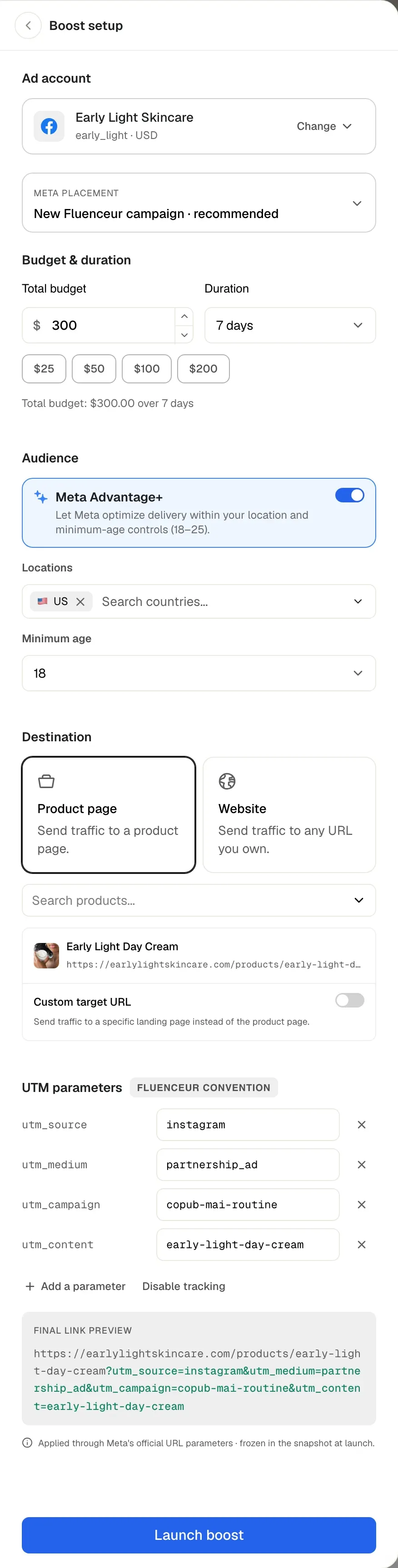
You set up a first boost from the mention, in one flow in Fluenceur.
- Request authorization. The request goes to the creator through Meta; without their approval, nothing runs. By default it applies at account level and covers their future eligible mentions; "Limit authorization to this mention only" narrows it to this one post.
- Propose display rights. Optional: compensation for running the creator's post as an ad, sent right after the request or later from their contact card. Once you propose them, the boost launches only when the creator accepts or you confirm an agreement obtained off platform, and Fluenceur pauses it when the rights run out.
- Ad account. It pays for the campaign. Fluenceur never modifies a Meta object it did not create.
- Destination and UTMs. "Product page" sends traffic to the product shown, via Shopify; "Website" to any URL you own. Never the homepage. Fluenceur adds its UTM parameters without overwriting yours.
- Total budget and duration. Seven days minimum: per Meta, an ad set leaves its learning phase "after about 50 results" in the week after its last significant edit.
- Audience. Meta Advantage+, on the locations you ship to, from your category's minimum age; a manual audience sets locations and an age range.
- Meta placement. "New Fluenceur campaign · recommended" isolates the boost; "Existing campaign" has Fluenceur add its own ad set without touching the rest.
"Launch boost" sends the campaign to Meta. Spend, purchases, cost per purchase and ROAS come back into Fluenceur, modeled by Meta, which adjusts them over 48 to 72 hours: wait that long before judging.
A worked example: $300 over seven days
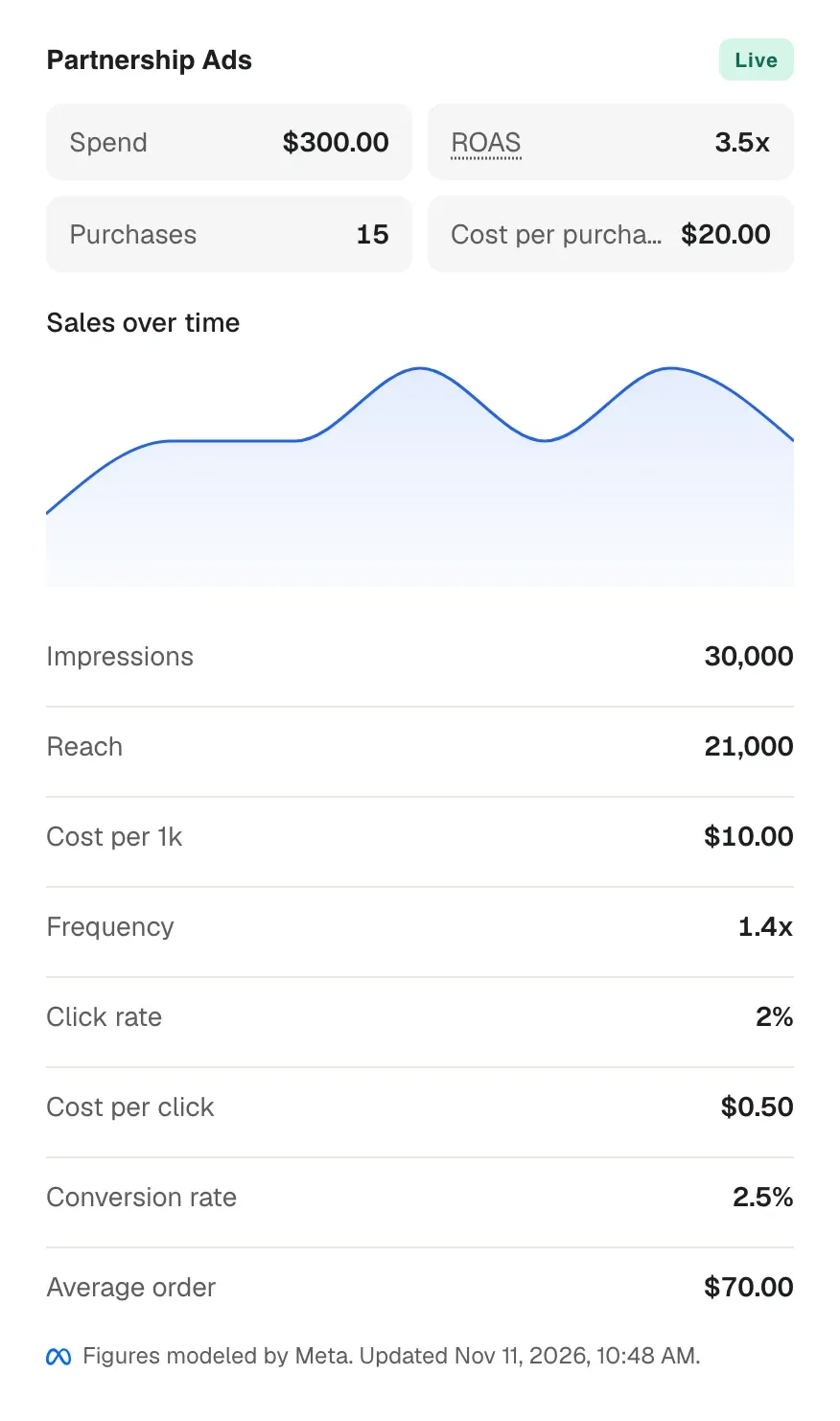
A hypothetical example. A skincare brand boosts the Reel of an affiliate creator whose code has already generated fifteen orders. Assumptions: $10 CPM, 2% click rate, 2.5% conversion on the product page, $70 average order, 10% affiliate commission.
| Line | Calculation | Result |
|---|---|---|
| Impressions | $300 ÷ $10 × 1,000 | 30,000 |
| Clicks | 30,000 × 2% | 600 |
| Purchases (modeled by Meta) | 600 × 2.5% | 15 |
| Purchase value | 15 × $70 | $1,050 |
| Cost per purchase | $300 ÷ 15 | $20 |
| Media ROAS | $1,050 ÷ $300 | 3.5 |
| Usage rights paid to the creator | 30-day flat fee | $150 |
| Affiliate commission | $1,050 × 10% | $105 |
| All-in cost | $300 + $150 + $105 | $555 |
| All-in cost per purchase | $555 ÷ 15 | $37 |
| All-in ROAS | $1,050 ÷ $555 | 1.89 |
At a 60% gross margin, $1,050 in sales leaves $630, $75 more than the $555 committed. After commission, every dollar sold leaves $0.50, so break-even is a ROAS of 2.0 on media plus rights (here $1,050 ÷ $450 = 2.33). Below that after 72 hours, stop and boost another post rather than adding budget.
The boost's sales are commissioned to the creator, like those from her link and code: her commission is part of your all-in cost.
Should you pay the creator for usage rights?
Yes, in most cases: commission pays for sales, not for running their content as an ad. Instagram tells creators they "can advocate for higher pay given the extended usage rights."
Our guide on how much to pay an influencer puts whitelisting at 30 to 50% above the base rate. For an affiliate with no fee, pay a flat amount for 30 days of delivery, renewable if the ROAS holds, and put platforms, duration and the right to hide comments in writing.
What does the FTC require on a partnership ad?
The FTC requires the paid connection to be disclosed clearly and conspicuously, and a platform's paid partnership label alone may not do it. Its Endorsement Guides FAQ puts the responsibility on the influencer and the brand, and says a platform's disclosure feature "is no guarantee" of an effective disclosure.
In practice, ask creators to open the caption with "#ad", readable without tapping "more": the FTC says that "would likely be effective." Meta lets advertisers edit content for an ad, so check the ad still opens with the disclosure before "Launch boost". Brands are also expected to train and monitor their creators.
What mistakes ruin a partnership ad?
Four mistakes cost budget or the creator's goodwill, and the first is the most expensive.
- Choosing on views: a viral Reel with no orders entertains, it does not sell.
- No written rights agreement: the creator can revoke, and the campaign stops dead.
- Editing too early: a significant edit restarts the learning phase, so nothing changes for 72 hours.
- Betting on one creator: three $300 boosts teach you more than one $900 boost.
Frequently asked questions
Do you need the creator's permission for a partnership ad?
Yes, always. Meta requires permission from the creator whose handle appears in the ad, for one post or for their content that tags your brand, and creators "can revoke these permissions at any time." Fluenceur sends the request from the mention.
Can you boost a Story as a partnership ad?
Meta allows it, Fluenceur does not: it boosts Reels and feed posts, which stay online with their engagement signals, while a Story disappears after 24 hours. If a Story sold well, ask the creator to turn it into a Reel, then boost the Reel.
What about TikTok?
TikTok has Spark Ads: a creator generates an authorization code so a brand can run their video as an ad. Fluenceur collects your TikTok mentions, but its partnership ads run through Meta, on Instagram only.
Key takeaways
- Boost the posts that have already sold through link and code, not the ones with the most views.
- First boost: $300 over seven days, product page, Advantage+, nothing touched for 72 hours.
- Pay the usage rights: that is the price of a creator who says yes, and who comes back.
Was this helpful?