ChatGPT
 Claude
 Perplexity
 Google AI
In this article
- In short
- Where do you find UGC creators?
- How do you search for UGC creators on social media?
- What should you look for in a UGC creator?
- How much does a UGC video cost in the US?
- How do you find UGC creators with Fluenceur?
- How do you write an open call for UGC creators?
- What do you do once you've found your UGC creators?
- Frequently asked questions
- Key takeaway
To find UGC creators for your brand, you have four routes: a UGC platform, searching social media, an agency, or an open call to your own customers. On all four, you pick a UGC creator on their videos, not their follower count.
Where do you find UGC creators?
UGC creators are in four places: on a UGC platform, on social media, on an agency's roster and among your own customers. The right pick depends on what you're shortest on: time, budget or a community.
| Route | What you get | What it costs | Best for |
|---|---|---|---|
| UGC platform | Creators who offer UGC, with samples and a rate you can see before the first message | The video and access to the platform | A brand that wants videos every month without spending weeks on it |
| Social media | Direct access, no middleman | Time: searching, writing, following up, negotiating, paying | A brand starting out on a small budget |
| Agency | Everything handled, from casting to editing | The video and the agency fee | A brand with budget and no team |
| Open call | Creators who already know the product | Sorting applications of uneven quality | A brand with engaged customers |
A UGC marketplace and a UGC creator platform are the same thing: a place to hire UGC creators, where the brand posts a brief, gets applications or picks from a catalog, then pays for the delivered video. What sets one apart from another is what it shows before you pay: sample videos, a rate, the rights included.
What should you look for in a UGC creator?
Judge a UGC creator on their past videos, never on their follower count: they are paid to create UGC content that runs on your product pages, your social accounts and your ads, not on their own account. Six things you can check in ten minutes per profile:
- The hook. The first three seconds make you want the rest, even with the sound off.
- On-camera delivery. They talk like a friend, not like a commercial.
- Picture and sound. Daylight, a clear voice, a label you can read on screen.
- The category. Three videos already shot for products close to yours beat a general portfolio.
- The match with your customer. Age, lifestyle, the problem to solve: the viewer has to see themselves.
- The terms. A stated rate, a turnaround, a number of included changes, rights in writing.
An account with 800 followers that checks all six will make a better ad than one with 80,000 that checks two. If you also want the creator to post on their own feed, you are no longer buying a video but an audience, and the pricing logic changes: see How much should you pay an influencer per post?.
How much does a UGC video cost in the US?
In the US, a UGC video costs $150 to $300 in 2026 according to the rate guides published by UGC agencies and platforms, around $100 for a beginner. These are vendor numbers. One creator marketplace's 2026 report, built on more than 21,000 collaborations on its own platform, puts the average asking price for UGC at $180 and the average price actually paid at $154. And in a 2026 industry benchmark survey of marketing professionals, roughly 80% of the cost ranges selected for UGC creators were under $500.
Three lines come on top of the video:
- Paid ad rights. Running the video in Meta Ads or TikTok Ads adds 20 to 50% for three to six months, according to the same rate guides.
- The product. Free to the creator, shipped before the shoot.
- The options. Hook variations and raw footage, itemized in UGC brief template: how to brief a creator for your videos.
A made-up example: Early Light Skincare tests five creators on its $42 serum, one video each, with paid ad rights for six months.
| Line | Math | Amount |
|---|---|---|
| Videos | 5 × $180 | $900 |
| Paid ad rights, 6 months | 40% of $900 | $360 |
| Free products | 5 × $42 | $210 |
| Test total | $1,470 | |
| Cost per ad-ready video | $1,470 ÷ 5 | $294 |
The test gives you five angles to compare in your ads. The two creators whose video holds up best get the next order, with three hook variations each.
How do you find UGC creators with Fluenceur?
In Fluenceur, Creator Discovery has a "UGC" mode: you describe the video, the search shows you creators who offer UGC, and every card shows their starting rate per video. You compare prices before you write to anyone.
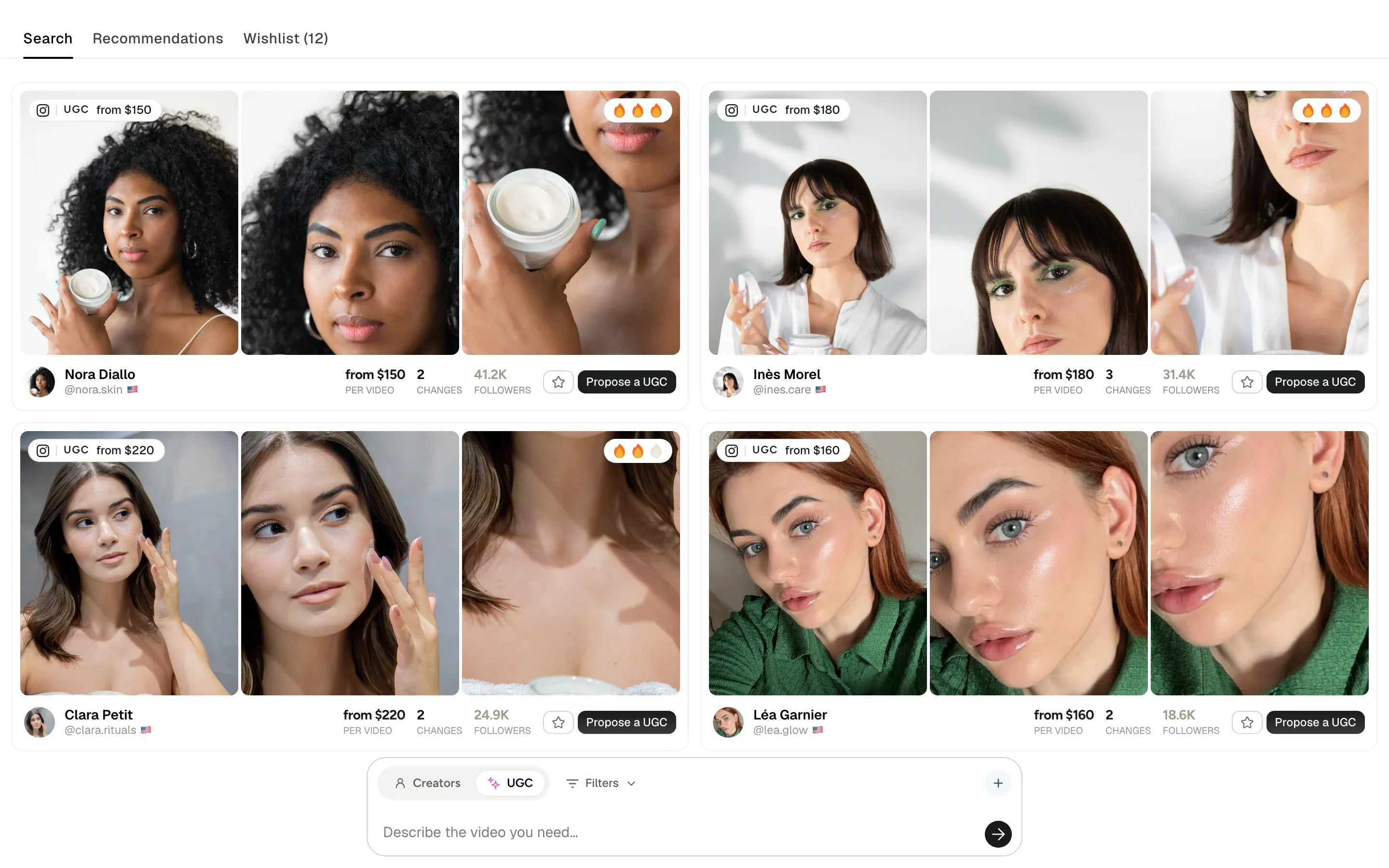
- Search. In UGC mode, or with the "Offers UGC" filter in a regular search. The creator's profile shows their video "Samples" and the number of modification requests included per content.
- Propose. "Propose a UGC" sends your brief to the creator: concept, deliverables, usage rights ("Organic" or "Organic and ads") and compensation.
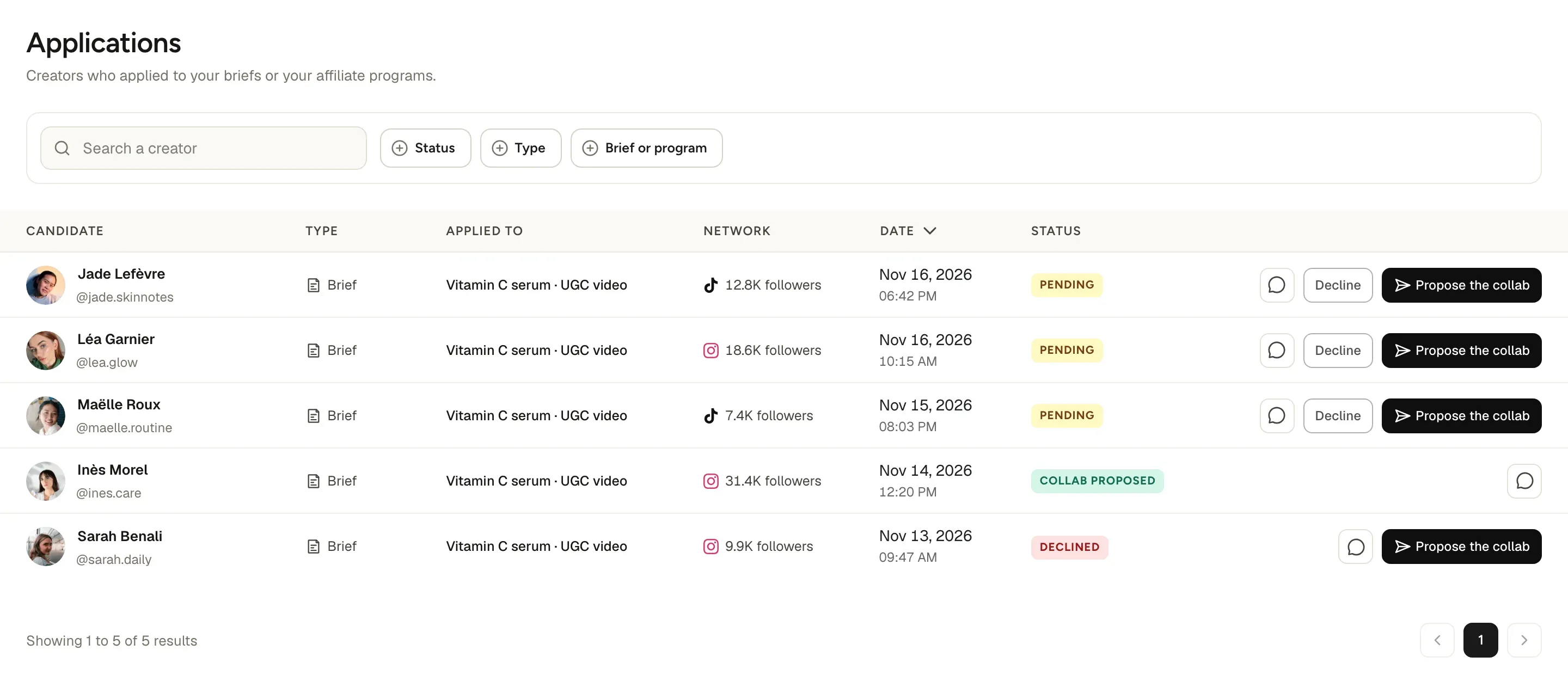
- Or let them come to you. "Open to applications" distributes the brief: interested creators apply, and their requests land on the "Applications" page, where you can "Message", "Propose the collab" or "Decline". Opening a brief commits you to nothing.
- Pay on validation. Fluenceur secures the amount when you fund the brief and pays the creator once every video is validated. You validate or ask for a change; each original file unlocks as you validate it.
The content is delivered to you, never published on the creator's account. The full path is on the UGC platform page.
How do you write an open call for UGC creators?
An open call fits in ten lines: the product, the video you want, what the creator gets, the rights you need, how to apply and by when. Email it to your customers and reuse it in a story. Early Light Skincare's example, to adapt; in a Fluenceur message, {{first_name}} and {{brand_name}} fill in at send time:
Subject: {{brand_name}} is looking for 5 UGC creators

Hi {{first_name}},

Already use our vitamin C serum, or want to try it? {{brand_name}} is looking for 5 people to film it.

The video: 1 vertical video, 30 seconds, talking to camera, shot at home. You don't post it: it runs on our social accounts and in our ads.
What you get: $180 per video, and the serum for free.
The rights: use on our social accounts, our site and our ads for 6 months.
You don't need followers: we look at your videos, not your numbers.

To apply: reply to this message with 2 videos you've already shot (for a brand or for yourself) by Friday.
Everyone hears back on Monday.
State the amount: a call with no pay attracts applicants you won't be able to brief. Reply to the people you turn down too: they're your customers.
What do you do once you've found your UGC creators?
Send a written brief before the product: one message, one audience, three hook ideas, the shots to film, the deliverables, the rights and the dates. The full template is in UGC brief template: how to brief a creator for your videos. Three regulars, briefed the same way from one video to the next, beat thirty one-offs.
Frequently asked questions
Can you find UGC creators for free?
Finding them, yes: social search and an open call cost nothing. Getting them to shoot to a brief, no: a briefed UGC video is a production, so it is paid. Content a customer posted on their own can be reused with their written permission.
Do you need a contract with a UGC creator?
Yes. Get the usage rights in writing, with the channels and the duration: without written ad rights, the video can't run as an ad. And make sure the creator actually uses the product. Under the FTC's Consumer Reviews and Testimonials Rule, in effect since October 21, 2024, your business can be liable if it knew or should have known that a hired creator misrepresented having used it.
How many UGC creators should you test first?
Three to five, on one video each. Fewer and you have nothing to compare; more and the sorting takes longer than the test saves.
Key takeaway
A brand finds its UGC creators through four routes: a UGC platform, social media, an agency or an open call. It picks them on their past videos in its category, not on their audience. It tests several on one video each, paid ad rights included, then orders more from the ones whose videos perform.
Was this helpful?