ChatGPT
 Claude
 Perplexity
 Google AI
In this article
- In short
- Brand ambassador program or one-off collaboration: what is the difference?
- Who should you recruit as brand ambassadors?
- What terms should you set before the first invitation?
- How should you pay brand ambassadors?
- How much does a brand ambassador program cost?
- How do you measure what each ambassador brings in?
- Frequently asked questions
- Key takeaways
To build a brand ambassador program, pick around fifteen creators who already love your products, give them written terms, a reward that grows with their sales, and a link and a code so you know what each one brings in. What separates it from the one-off collaborations you run today is time: an ambassador talks about you every month, not once.
Brand ambassador program or one-off collaboration: what is the difference?
A one-off collaboration buys a post; a brand ambassador program sets up a relationship of several months with the same creators.
| Criterion | One-off collaboration | Brand ambassador program |
|---|---|---|
| Length | One post or one campaign | Several months, renewable |
| Pay | A flat fee per deliverable | Product, commission, sometimes a flat fee |
| What you get | A spike in reach | Content and sales every month |
| What the audience sees | An ad | The same person still using the product |
| What you measure | This week's views | Each creator's sales, month after month |
| When it fits | A launch, a dated promotion | A product people rebuy or recommend |
One leads to the other. The one-off collaboration is the test, and the creator who sold becomes an ambassador. Three signs say it is time to build a recurring influencer program: you keep rebooking the same creators, you renegotiate every time, and you cannot say which one sold.
In a 2023 survey of 35 marketers, all customers of the influencer software vendor that ran it, over 90% called their ambassador program ROI-positive and none was considering stopping it.
Who should you recruit as brand ambassadors?
Recruit in this order: your customers, the creators already talking about you, then applicants. All three share one thing: they no longer need to be sold on the product.
Your customers. Some of your buyers already post on Instagram or TikTok. In Fluenceur, the "Customer to programme" Flows template invites a Shopify customer to become an affiliate after their order. If you already keep a list of ambassadors, "Import from CSV" adds them to the program in one go, with their existing discount code if they have one.
The creators already talking about you. Your own mentions are the first place to look. Fluenceur's Social Listening gathers the posts that name or tag your brand, and "Invite to Program" sends the invitation from the conversation. The full method is in How to find influencers already talking about your brand.
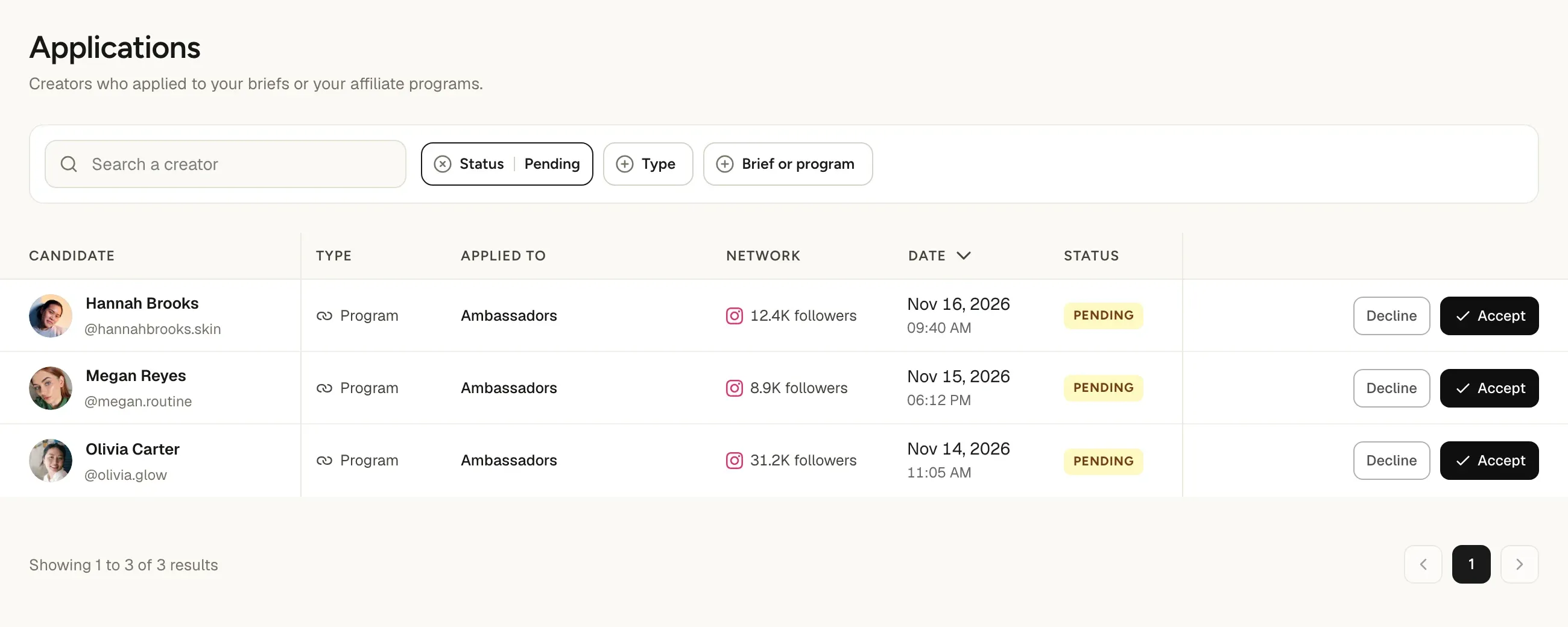
Applicants. Your Brand Space is the public page your brand shares with creators. Its "Affiliate program" section carries the program title, its perks and an application form whose questions you write. Every answer lands in "Applications": "Accept" sends the creator an invitation to join the program. Put the page link in your site footer and in your bio.
Start with 10 to 20 ambassadors: enough to compare, few enough to answer each one. Three questions are enough: do they use the product, do they post every week, does their audience look like your customers?
What terms should you set before the first invitation?
A one-page charter, sent with the invitation, that says what the ambassador does, what they get and how either side walks away.
[BRAND] AMBASSADOR CHARTER

Term: 3 months, renewed if it works for both of us.

What you do: 2 pieces of content a month (short video or carousel), on the account you choose. You pick the angle and the words. We send you product talking points and new launches ahead of time.

What you get: a welcome kit, [X]% commission on every sale through your link or your code, and every new product before it ships.

Your link and your code: they are in your name. Your audience gets [X]% off with your code.

Tiers: at your 10th sale, your commission goes up to [X]%. From $[X] in sales, we add a monthly flat fee.

Your content: we can repost it on our accounts with credit. To run it as an ad, we ask you first and agree on a price together.

Disclosure: every post says "#ad" or "[Brand] ambassador" up front, in the post itself, not buried in hashtags.

Exclusivity: no paid content for a competing brand during the program.

Exit: either of us can stop with 15 days' notice. Commissions owed are paid, the code is turned off.
In its FAQ on the Endorsement Guides, the FTC says an ambassador who gets free product or a commission should disclose it clearly, and that brands need reasonable programs to train and monitor their ambassadors. It calls a bare "#ambassador" ambiguous and suggests naming the brand, as in "#XYZ_Ambassador", which is why the charter spells out the wording.
How should you pay brand ambassadors?
Stack three rewards: product to start, a commission on every sale, then a flat fee for those who have proven themselves.
| Reward | For whom | What it buys | Its limit |
|---|---|---|---|
| Free product | Every new ambassador | An honest first post, at no risk | Does not keep a creator who sells |
| Commission on sales | Everyone | A cost that tracks your revenue | Uncertain income for the creator |
| Flat fee plus commission | Your best ambassadors | A guaranteed posting cadence | A cost even without a sale |
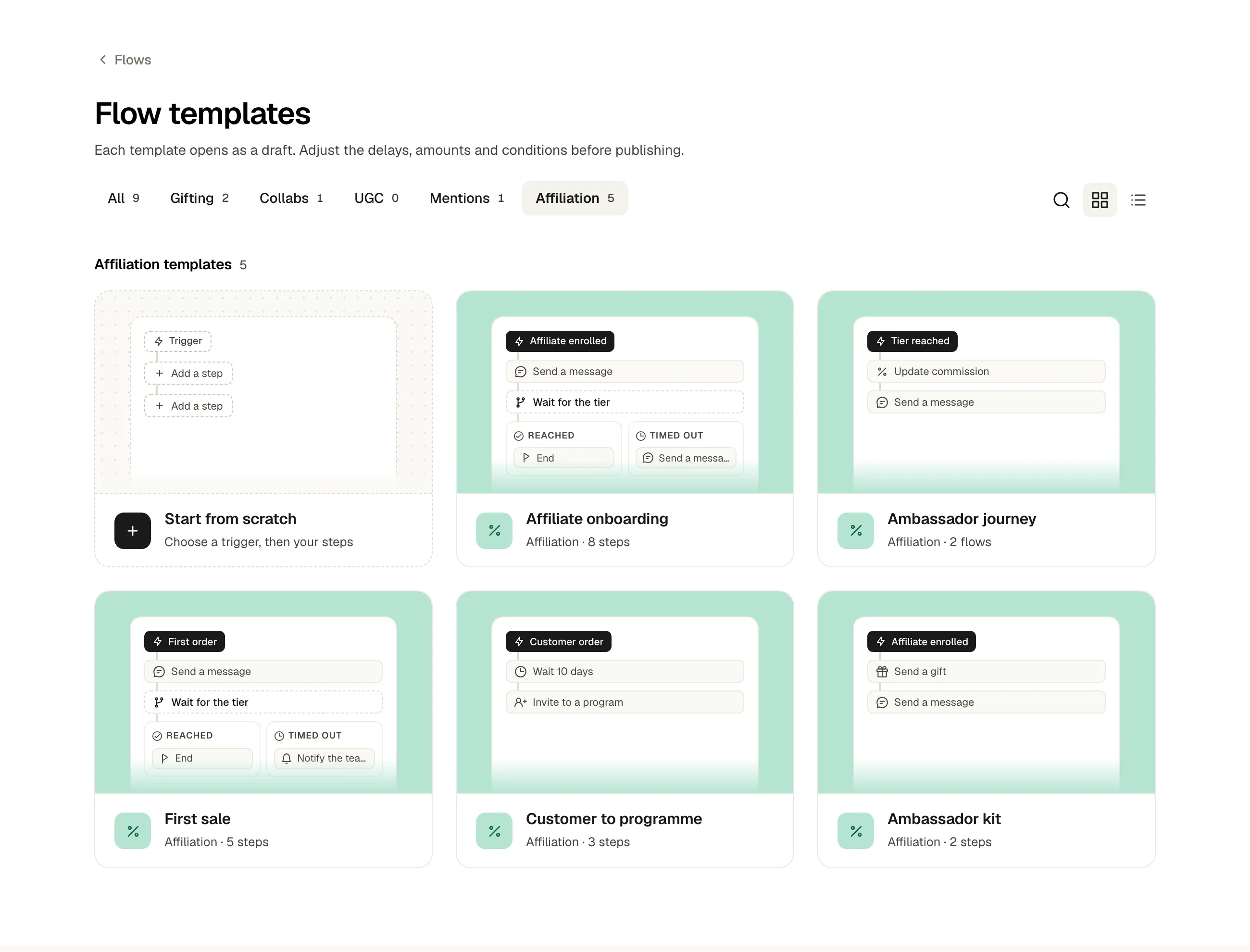
Product. Fluenceur's Gifting ships the welcome kit from your store. The "Ambassador kit" Flows template triggers it when the ambassador enrolls, then sends the visuals and product talking points.
Commission. In the affiliate program, "Edit Rewards" sets the commission as a "Percentage" or a "Fixed Amount" per order. A "Special reward" pays more on the first purchase of each new customer, where an ambassador is worth the most to you. You can also give one ambassador a custom rate. To choose the rate itself, start from your margin: What commission rate should you pay creator affiliates?.
Flat fee plus commission. Fluenceur also offers the flat fee plus commission collaboration: the ambassador gets a guaranteed amount for the month's content, then their commission on every sale. Keep it for those whose numbers justify the commitment.
Tiers. The "Ambassador journey" Flows template rewards your best affiliates tier by tier: a higher commission at "Ambassador · Silver", then a gift at "Ambassador · Gold". It opens as a draft, and you set the thresholds and amounts before publishing.
How much does a brand ambassador program cost?
A brand ambassador program costs kits and a few flat fees paid up front, then a commission on every sale: in the example below, $2,406 over a quarter for $6,840 in validated sales.
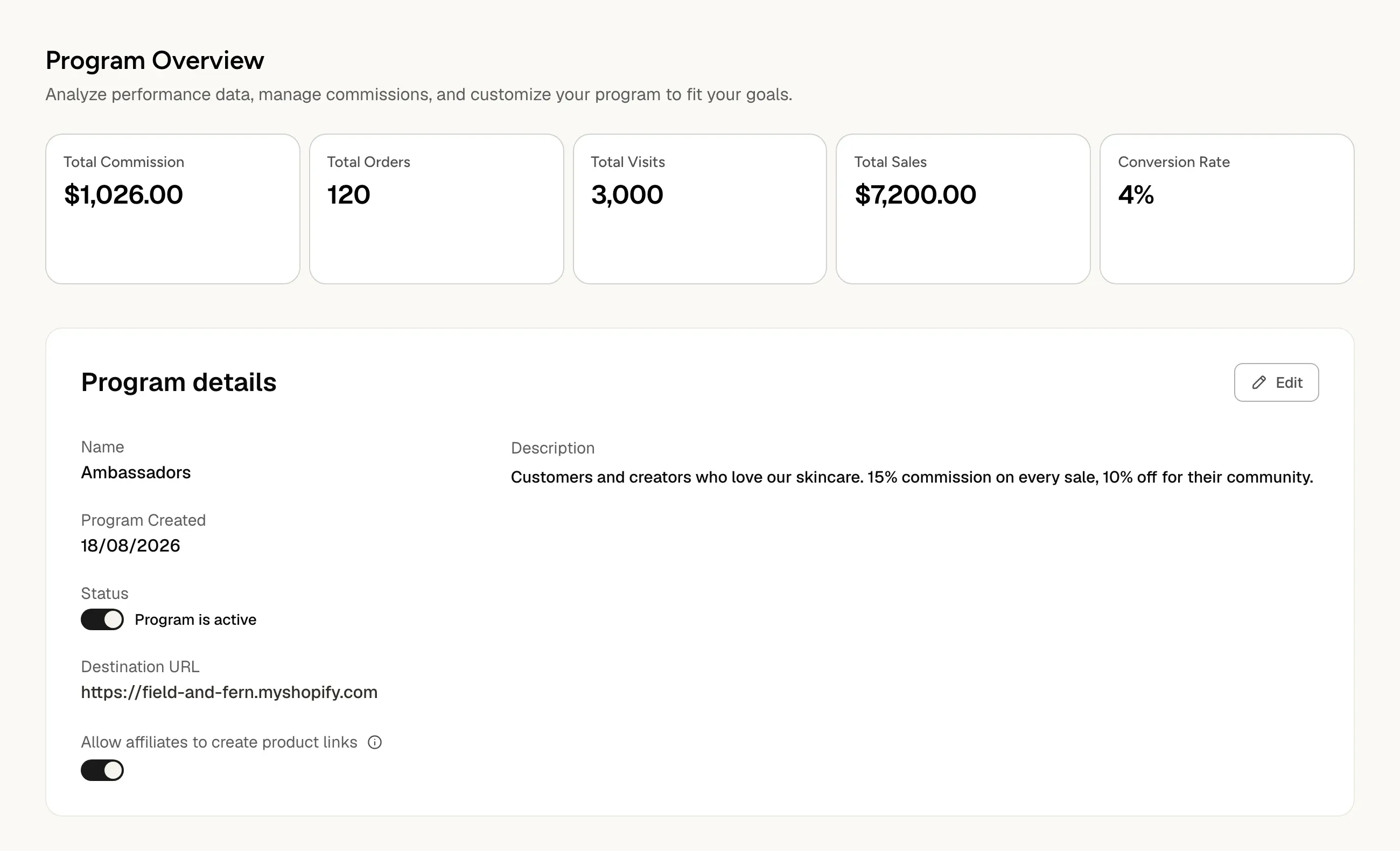
Field & Fern is a fictional skincare brand. It starts 15 ambassadors for three months, at a 15% commission and a $60 average order after the code discount. Two of them get a $150 monthly flat fee.
| Line | Calculation | Amount |
|---|---|---|
| Attributed sales | 120 orders × $60 | $7,200 |
| Refunds | 5% of sales | − $360 |
| Validated sales | $6,840 | |
| Gross margin | 65% of $6,840 | $4,446 |
| Commissions | 15% of $6,840 | − $1,026 |
| Welcome kits | 15 × $32 (product and shipping) | − $480 |
| Monthly flat fees | 2 × $150 × 3 months | − $900 |
| Net result | $4,446 − $2,406 | $2,040 |
Only the kits and the flat fees are committed up front: $1,380. Every validated dollar leaves 50 cents of margin after commission. The program breaks even at $2,760 in validated sales, or 46 validated orders over the quarter. Add your tooling and your team's time: the ROI calculator runs the same math on your numbers.
How do you measure what each ambassador brings in?
Give each ambassador a tracking link and a discount code in their name, and read the two together. The link catches purchases made without the code, the code catches purchases made without a click: Measuring creator sales covers the rule that settles conflicts.
Fluenceur generates each ambassador's link as soon as they enroll, and their code as soon as the program offers a discount. The "Program Overview" then shows "Total Visits", "Total Orders", "Total Sales", "Conversion Rate" and "Total Commission". Each ambassador's profile shows their revenue, orders, visits and commission. The Affiliation page shows the whole setup.
Every 90 days, sort the group into three piles:
- Those who sell. Move them up a tier, offer them the flat fee plus commission.
- Those who post without selling. Plenty of visits and few orders: change the landing page or the product they feature.
- Those who stopped posting. One reminder, then pause their affiliation. The spot goes to a new applicant.
Frequently asked questions
What is the difference between an ambassador program and an affiliate program?
Affiliate is the mechanism: a commission on every tracked sale. The ambassador program is the relationship built on top of it, with a selection, a charter, product and tiers. A good ambassador program runs on an affiliate program.
How many followers does a brand ambassador need?
There is no useful minimum. A customer who films themselves with your product every week for 2,000 followers can outsell an 80,000-follower account that never opened the box. Judge product use and consistency, then let sales decide.
Can you start a brand ambassador program with no budget?
Almost: with product and a commission, the only cost committed up front is the welcome kits; the commission is only paid on a sale you have already been paid for.
Key takeaways
- A brand ambassador program turns your best collaborations into a relationship of several months, paid first on sales.
- Brand ambassadors are recruited from your customers, your mentions and your applicants, with a written charter sent with the invitation.
- Each ambassador gets their own link and code, and the group is reviewed every 90 days: reward, fix, pause.
Was this helpful?