ChatGPT
 Claude
 Perplexity
 Google AI
In this article
- In short
- DM or email: where do you reach out to influencers?
- What do you say in a first influencer outreach message?
- Which influencer outreach email template fits your collaboration?
- What should you leave out of the first message?
- When and how do you follow up with an influencer?
- How do you track replies when you reach out to dozens of influencers?
- Frequently asked questions
- Key takeaways
To reach out to influencers, send each one a short, personal email that says who you are, why them, what they get and what answer you need. Five sentences are enough. The brief, the contract and the details come after they say yes.
DM or email: where do you reach out to influencers?
Reach out to an influencer by email whenever they list an address, in their bio or behind the "Contact" button on their profile. Creators say so themselves: in a 2021 HypeAuditor survey of 1,656 creators, 51% preferred to be contacted by email and 40% directly on their social platform.
Email has three advantages over a DM. It lands in an inbox the creator checks for work, while a DM from an account they don't follow usually ends up in message requests, buried with everything else. It leaves room to state an offer. And you can find it three weeks later, when it's time to follow up.
The DM still has a job: opening the door with a small creator who lists no address. Two lines do it: "Hi Camille, loved your winter routine series. We'd like to talk about a collab with Juniper & Oak. What's the best email to reach you?" The offer then goes out by email.
Start with creators who have already tagged you: they know the brand, so you can skip the introduction. Fluenceur's Social Listening finds them for you; see how to find creators already talking about your brand.
What do you say in a first influencer outreach message?
A first influencer outreach message says four things, in this order: who you are, why this creator, what they get, what you need from them now.
- Who you are: your first name, the brand and what it sells, in one sentence. Sign with a person's name, not "The marketing team."
- Why them: one specific piece of content you watched. "Your winter routine video" proves this isn't a mass send; "love your content" proves the opposite. In the same survey, 43% of creators said they never or rarely receive a personalized message.
- What they get: the product, the commission or the budget, with a number. The creators surveyed want a product description first (61%), then budget and deliverables (59%).
- What happens next: one question they can answer in one line. "Want me to send the link?" gets a yes; "What do you think?" asks the creator to write you a reply.
The subject line gets read before anything else. Put the offer and the first name in it, not your campaign name: "15% on every sale, Camille" makes sense without opening the email.
On tone, write the way the creator talks to their audience: first name and plain sentences for an Instagram or TikTok creator, a more formal note for an expert (a doctor, a chef, a journalist) or a manager.
Which influencer outreach email template fits your collaboration?
The message changes with what you offer: free product, a commission or a fee. Here is one template per case, to adapt to your brand. The brand is fictional: Juniper & Oak, a skincare line.
1. GIFTING (free product)

Subject: Our repair balm for you, {{first_name}}?

Hi {{first_name}},

I'm Maya from Juniper & Oak. We make skincare in Portland, and your winter routine video made me think of our repair balm.

I'd love to send you one, with no obligation to post. If you do share it, just mention it was a gift.

Want me to send you a link to pick your scent?

Maya


2. AFFILIATE (commission on sales)

Subject: 15% on every sale, {{first_name}}

Hi {{first_name}},

I'm Maya from Juniper & Oak. I've followed your skincare tips for a while, and the questions in your comments sound a lot like the ones our customers ask.

I'd like to invite you to our affiliate program: 15% commission on every order placed through your link, and 10% off for your followers. Post whenever you like, no commitment.

Want me to send the invite?

Maya


3. PAID COLLABORATION

Subject: Paid collab in March, {{first_name}}

Hi {{first_name}},

I'm Maya from Juniper & Oak. We launch our repair balm on March 2, and your "evening routine" series would be a great fit.

The ask: 1 Reel and 3 Stories between March 2 and 15. The budget: $500, plus the product. You keep your voice; we only fact-check the product claims.

Do those dates work for you? If so, I'll send over the brief.

Maya
What changes from one template to the next:
| What the message states | What it asks for | |
|---|---|---|
| Gifting | The product, no strings attached | A yes, then the product choice |
| Affiliate | The commission rate and the discount for the audience | A yes, then signup through the link |
| Paid collaboration | The deliverables, the dates, the budget | A yes on the dates, then the brief |
To set your numbers before you write, see how much to pay an influencer, gifting from Shopify and, for commission rates, how to build a brand ambassador program.
What should you leave out of the first message?
Leave out everything that can wait for a yes.
- The full brief. Three paragraphs of instructions before any agreement scare creators off. State the format and the dates, not the script.
- The contract and attachments. An attachment from a stranger looks suspicious; it can wait for the yes.
- The vague promise. "Great exposure" and "a win-win partnership" are not an offer.
- The generic compliment. If it could go to a hundred creators without changing a word, cut it.
- Three questions at once. Ask one: the one that moves things forward.
One legal point to keep in mind: in the US, the FTC says a creator who gets payment, free or discounted product or another perk from a brand must clearly disclose that connection when they mention its products, and that a brand sending free product should ask for that disclosure. That is why the gifting template does.
When and how do you follow up with an influencer?
Follow up in the same thread, usually about a week after the first message, with one new piece of information, and stop after a second follow-up. Creators get a lot of pitches; silence isn't a no yet.
The new information gives them a reason to answer now: limited stock, a launch date coming up, a new scent.
"Hi Camille, circling back: we have ten balms left to give away before our March 2 launch. Want me to set one aside for you?"
No answer after two follow-ups? Move on to the next creator, but keep them in your wishlist: they may say yes to your next campaign.
How do you track replies when you reach out to dozens of influencers?
You track replies with a status per creator; without one, you follow up twice with the same person and forget the one who said yes. Fluenceur keeps that tracking for you.
In Creator Discovery, the "Save" button files a creator under the "Wishlist" tab. Each row keeps their email, your notes and a status: "Not Contacted", "Contacted", "Pending" or "Joined". The status switches to "Contacted" on its own as soon as an email or an invitation goes out from your wishlist.

From there, "Send outreach email" sends from your own Gmail or Outlook mailbox, connected to Fluenceur: the creator gets an email from a person, at your address. Select several creators and "Send email" sends to all of them; variables drop each creator's first name and your brand name into the text. A message that works can be saved as a template.
Beyond email, "Propose a collab" sends your collaboration proposal to the whole selection. There, the "Personalize with AI" option adapts your message to each creator based on their profile, such as their category and their account. For invitations to your affiliate program, the Invitations page shows a status per creator, such as "Pending", "Clicked", "Joined" or "Expired", and a "Follow up" button.
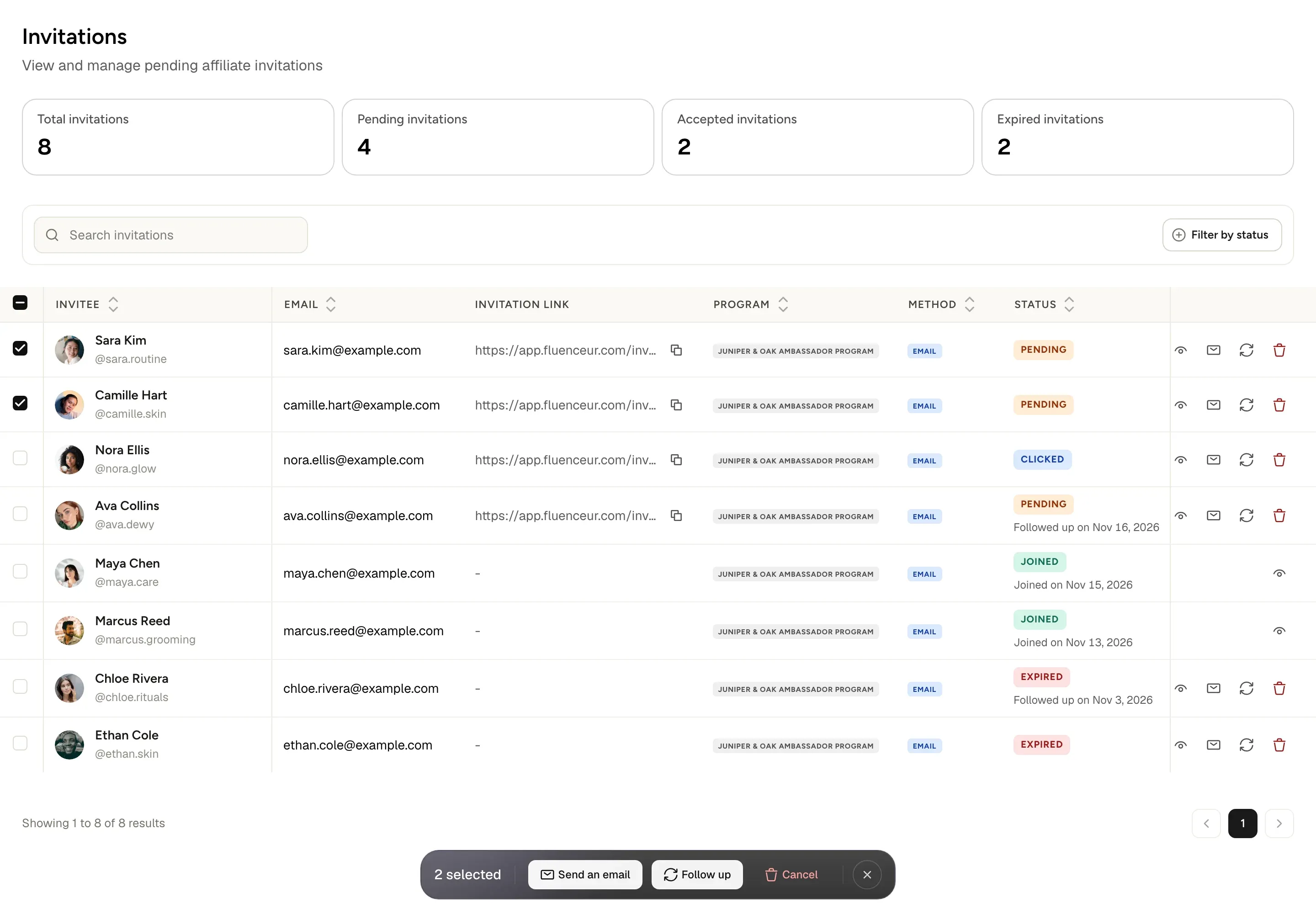
An invitation sent through Fluenceur's own email and left unanswered gets an automatic reminder. When you wrote from your own mailbox, the follow-up is yours to send, and Flows handles it: the "Unanswered proposal" template follows up a collab proposal or a program invitation twice, then alerts your team, at the pace and with the wording you choose.
Frequently asked questions
How do you find an influencer's email address?
Beyond the bio and the "Contact" button, check the "About" page of their YouTube channel, their website and their link-in-bio page. Fluenceur does that search for you: when a creator's address is public, it comes with them into your wishlist.
Should you go through an influencer's agent?
Yes if their bio names one: that's their instruction. Otherwise write to them directly. In the 2021 HypeAuditor survey, only 15% of creators worked with an agent or talent agency, and two thirds of those still preferred brands to contact them directly.
Does the same message work for a UGC creator?
No. A UGC creator sells a video, not an audience: your message covers the format, the price per video and the usage rights. See how to find UGC creators.
Key takeaways
- A first message takes five sentences: who you are, why this creator, what they get, one question.
- The first message puts a number on the offer, and it changes depending on whether you offer product, a commission or a budget.
- Tracking makes the difference at scale: a status per creator and one follow-up, two at most.
Was this helpful?